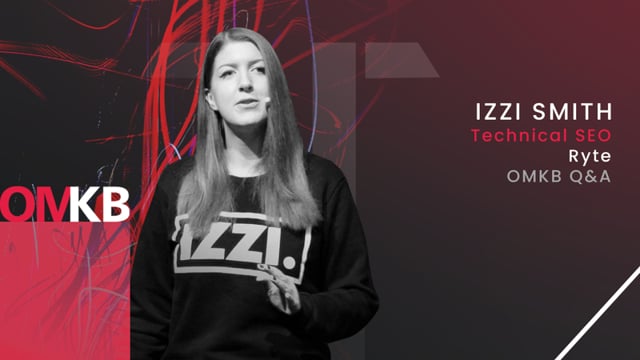
(Electronic Musik spielt im hintergrund) Erst bei uns tatsächlich jetzt ohne Pause weiter in den nächsten Themenkomplex. Und zwar ist es so, dass wir uns entsprechend weit einem weiteren SEO-Thema widmen werden und die zauberhafte Izzy Smith begrüßen dürfen. Ihrerseits auch English Speaking Native. Das bedeutet, der nächste Vortrag wird entsprechend auch in englischer Sprache gehalten. Izzy selber hat, äh, im Bereich der Suchmaschinenoptimierung tolle Erfahrungen sammeln können, weil sie über fünf Jahre bei 6ixd, sicherlich ein Name, der euch allen bekannt sein dürfte, im Bereich SEO-Optimierung, ähm, und internationaler Strategieauslegung aktiv gewesen ist, hat sich um Content-Strategien dort gekümmert, auch preisgekrönt tatsächlich, das Thema Featured Snippets und Rich Snippets und ist eine wirkliche Koryphäe in ihrem Bereich. Izzy selbst ist mittlerweile beim Toolanbieter Ryte aktiv seit einiger Zeit und dort verantwortlich für den Ausbau des Geschäftes und der Plattform Ryte, eine der führenden SEO-Marketing-Plattformen überhaupt weltweit. Und Izzy selber ist, ähm, erfahrene Speakerin aus den unterschiedlichsten Konferenzen, hat in der Vergangenheit beispielsweise schon auf der SMX gesprochen, ist auch in diesem Jahr wieder stark gebucht, logischerweise, in, äh, vielen digitalen Konferenzen und verfügt auch, darauf möchte ich auch noch hinweisen, über einen eigenen Podcast tatsächlich mit einem Kollegen, The Izzy and Nils Show mit Nils Katau, wo das Thema Suchmaschinenoptimierung und Conversion-Rate-Optimierung immer wieder Thema ist und ganz aktuelle Themenkomplexe und Trends aus dem Bereich besprochen werden. Ich freue mich sehr, dass wir Izzy heute im Rahmen der OMKB für unser Line-up gewinnen können und Izzy startet gleich mit dem Vortrag durch: Digging into Advanced Google Search Console: Search Performance Patterns. Wir rücken also das Thema der Google-Search-Console, der effizienten Bearbeitung der Informationen, die ihr über Google-Search-Console entsprechend über Search Volume, Search Patterns und Co. identifizieren könnt, in den Fokus des nächsten Vortrages. Izzy wird sehr praxisnah, sehr praxisorientiert, sicherlich den einen oder anderen spannenden Insight dabei haben und ich wechsle jetzt, wie vorhin auch, einmal Sprache Richtung Englisch und hoffe, dass Izzy uns technisch zugeschaltet ist und mit zuhört. Hello, Izzy. I hope you can hear and see me. Hallo. Yes, thank you so much for the wonderful introduction. I understood maybe sixty percent of it, but I think I got the general vibe of it. Thank you. That's still a lot. That's still a lot. Yes. You're in Munich today, aren't you? Yes, I live in Munich and during quarantine, I'm happy to say that I've been finally taking German lessons. So maybe one day in the next few years I can finally give a talk in german. That's my goal. That's a huge goal, isn't it? Yeah. Ahm, I was talking about your professional career at being at sixt, learning SEO strategies, content marketing strategies. But can you do me a favour and just point out in two or three sentences: What's your jo-- What's your job and profession at Ryte right now? Sure. So I joined Ryte in December 2019 and basically I help many of-- many different teams over there. So I help the product team understand what SEOs really need and their daily workflows and I also assist the customer support team with helping our clients get the most out of the software as well as assisting marketing with our own SEO. So quite a lot of different things to work on. It's very exciting. Yes, ähm, and we are really excited to have you in our line-up today and to hear your session about the Google Search Console Search Performance Patterns. And the stage is yours. As I know, Izzy is always on fire. Thank you. So we are looking forward to your ses-- session, Izzy. Enjoy and we are seeing you afterwards in our Questions-and-Answers-part. Have a great time. Thank you so much. Thank you. Are you all able to see my screen? Yes. Yes? Looks perfect. Fabulous. Let's do this. Okay, so I don't even need to introduce myself, but maybe something worth mentioning is that I do enjoy making bad SEO-jokes and SEO-memes. I have a few of them throughout the presentation. But, ähm, if you want to see more, please follow me on Twitter. I also post occasional or frequent SEO-tips. And if you have any questions about this presentation that maybe I didn't get to cover as much as I would like, then you can always e-mail me via izzy@ryte.com. So let's get straight to the topic today. A wonderful thing that I always enjoy talking about is Google Search Console Search Performance Data. And anyone who claims to do SEO, even if it's full time or on a hobby basis, you need to have this platform in your toolset. We have so much information available here. We can retrieve URL-information. So recently, Google paused the availability to directly push changes to the index. They said this will be coming back soon, but who knows when and if that will be the case. We also have, äh, reports around indexing issues and coverability, accessibility, page speed, all sorts is going on there. But today I'm really going to be focusing on your real organic search performance data and how you can really get the most out of the metrics and KPIs that you see there. So within the search performance area, we can evaluate the status of our organic rankings and then tie optimizations that we've made to the significant movements in Rankings, clicks, impressions and so on.We can it's finding potential for increasing traffic and keep driving clicks to solidify, der high ranking to work so hard to ich und den keep running optimiert. Sehen jetzt hier unten Content an Der. Skizze Our organic reach. So lots of wonderful things we can do it is data. Ich habe wirklich ist home to the most powerful data set we have, but die Interface really limits our potentials of slicing and dissing this data zu Hause needs unfortunately so let's take a glance at Google Search Console Search Analytics. This is data straight from the horse's mouth, which is a weird English saying I don't know of the German Äquivalent, but basically this is data coming from the primary or the major search engine. Dat wir work so hard to be. So we really need to understand und grasp this data and not just the snapshot of data that we received from rank tracking tools which to help us with competitor analysis, but when it comes to our websites analysis we need this GSC data. Google Data ist far more reliable than scrape data. If you looking at finding cases of potential optimizations and for finding cases of why you can keep growing in its from the source again and it paints a much more authentic picture of how your domain and how your content is actually performing. Aber there are some issues. Of course, each request, as we know, is limited to 1000 rows. So if you have a large domain, the ranks für lots of keywords or even if you have a small domain, it's likely that you're going to rank for a lot of keywords with the content that you create. So you want to make sure the just seeing the full scope, because you're not entirely aware or you can't be entirely aware of how large an issue is or of how this potential this gap is. If you want to drill down into data, it's almost impossible. So you're limited to applying only one filter at a time and there's no chance of and or functions, so you can't really get down into the nitty gritty of what you're looking for. Und yes, it's free, which is great, but our time as SEOs isn't. Und das kann take a lot of time to analyse to uncover what's going on in the average position. Data and really see what is creating traction from our optimizations, which is why we really need to make use of the API to the best of our abilities. This is also free. It lets pull in the data and refine it and make the very most out of it and other platforms available to us like Google Sheets or Google Data Studio. Ich kann. Really recommend building a highly actionable search console performance Dashboard Las Olas has a great template if you're struggling with getting started. Das ist how it looks like here. Oops, don't want to hit my microphone, but yet if you want to get started, please check that out. Also had a Rampton, who is another wonderful SEO created as a Google Sheets that pulls in the GSC data and helps you explore it in much better ways. And now recently over summer she created a very vast search console Explorer Studio. Or if you have tons and tons and tons of data with limited time like myself, a platform like right search access, which is pulling in as much GSC data as possible and then refining it into actionable reports. But it doesn't really matter what tool you're using honestly, as long as you are using this Google Search Console Performance data for analysing your real performance. So however you like it, just use it only in search console. You can see what is really happening. It's your data, you already have access to it and it's free. Why wouldn't you? So use it. But use it wisely. An Icon stress not enough. You need to know what to look out for. You shouldn't get lost by average positions or misleading CTRs that are forcing you to go down the wrong path or high impressions for keywords that you simply can't achieve sustainable traffic via remember our time as SEOS. Ich denke now more than ever is really precious. So use it as wisely as you can and turn your Google Search Console data into a masterpiece. So based on my tinkering also with my technical SEO Analyst Team, that Wissen sich aus mir, Markus Tanzer und Alex Breitenbach, we're a great trio of SEOs. Wir sind tasked, tasked sometimes by our beloved clients who are struggling a Leiter bet with their search performance and they need a sparring partner to help them analyse the data. So sometimes they ask us questions and we'll dig in and we'll retrieve what we find. This is a really amazing and fun part of my job and naturally we analyse a lot of Google Search Console properties on a daily basis. So today I wanted to provide to you all the wonderful OKB audience. Ich wollte show you the most common patterns that we come across in our work using Real life GSC Data of course for our clients sake. It's anonymized in many places, but I also have some cool case studies from our own right domains. So the first point is all about performance based core update impacts in the May Core Update this year our work was really cut out for us. We had a lot of exciting stuff to dig through, like really checking what is happening, what is moving and why.Und. Now: Relevanz. Sehen. Das ist, wenn Google has perceived. You ranking for irrelevant query. Die Juroren auf der Syphilis Jussi los rankings gegen not with the seed in the search results. So you want to share is. Why? They were impacted und how so put the reasons. Im Buckels of why Customer. Jetzt. Nur die first one is. The first one is all about relevance. Ich will nicht sagen, dass es für die Ranking forever relevant crities. Die Juroren sind bei uns und müssen. Jussi loves rankings against not always a bad thing. Es gibt Shift in search results. You want to share to traffic to your website. Traffic. Purpose on your website. Ich habe been. Expertise authoritative. Haps Google so you is requiring high. Reality for your industry. Wetter. Medical Finance ich könnte even be commerce zu sammeln. Stand and I can's proof that you. Ich könnte also bei dir performance I see you as well as related to relevancy simple just not bringing in the clicks. Further queries, ranking vor well standing aus maybe you not providing experience in your website creating low. Value Experience on your website and Google world and over time and one fell swoop remote your website. Oder It could be something completely else completely different. It could even be reversal of a previous core update. It could be factors from all of them. But today I point out something that we can really analyse better without Google Search Console data and that is the under performance factors getting us down. Now this could happen gradually over time or it could happen in one shot. Post a core Update. So lets take a look at one significant case study. This is what a pretty typical core update looks like. You can really clearly see the drop in impressions and clicks in May 2020 as well as the number of ranking keywords. It is especially this drop in the number of ranking keywords, which is important because around Christmas you could see a very similar drop in impressions and clicks. But here the number of keywords stayed the same and even increased a little bit. So people were just searching for the same keywords, just in lower volumes, which was very it was very relevant for this type of website. So we were very certain this was a core update. Lets take a look into some of their focus keywords individually. So high priority keywords that make a lot of sense for their business goals. If we check them out, which have been affected by the core update, you can observe a very similar pattern. They start getting tested within the top ten, so that's the position line there, the purple one up top and they fail to entice their users. So there really showing to Google that they were not worthy of their high position. So with it tanks their position and impressions we have the same exact behaviour with this other affected keyword. There going down and another really juicy keyword. So always take a look. Sorry, I forgot to mention the amount of impressions there. There is a high amount of impressions and they were doing pretty well on the top ten. But just a CTR 0.1 % was simply not cutting it for these keywords that had a lot of intent to click through to the website. And all of these were really clear signs to big G so big Google that they were not worthy. They were not a correct fit for this type of keyword and they were demoted on a large scale during the core update. Now We've seen this happen for quite a few domains that came to us during the Make Core update. So we learned quite a few lessons. For example, being really wary of your risky underperformance. So these click worthy terms that have a high position and a low click through rate because this could be a clear sign to Google that your low quality, you're not relevant enough and you deserve to be on page two or lower. You should really use a holistic and fair approach when you're diagnosing core update drops. If you're just using visibility data, it might not always be completely indicative if you have been impacted. So you rely solely on your own data such as your GSC clicks your amount of keywords that you're ranking for. Also you Google Analytics traffic to confirm that to really conclude if you are impacted by a core update or not. The second pattern, that I like to talk about often are vanity terms or keywords that are simply unsustainable. Now, I want to explain this with some examples from our own domain. So a clear navigational query bing here. Quite funny, that a lot of people are searching on Google for Bing Interesting, which has a heck ton of impressions. And we can really see when these top ten tests that I just mentioned are happening when they're taking place because this huge peak in impressions is corresponding with that.Aber of course now one is going to click through to our informational wiki article about Bing and, you know, SEO on Bing, because people are ho-hoping to navigate to the actual search engine, to those services related to Bing. And Google perceived this. They saw that no one was really interacting. We have less than 0,1 % CTR and therefore we dropped down to page five. But, ja, it is not all bad here. So, another example that sums this up nicely. Äh, so a really high volume, yet pure answer intent query is SERP. So, people are just really looking for the definition of the acronym SERP. So, Search Engine Result Page, hier. We, first we got qualified for the test on page two, via those classic ranking factors that we work to achieve. And then we got tested in the top ten for a couple of months. Something worth pointing out here is, die Length of those tests really depend on the number of searches, ähm, made, because Google really needs to ensure there is statistical relevance with these. But still, there was no clicks to our website. We just can't entice users to click to our web, to our page ranking there. So, bye-bye, page one and two, and we got pushed down to page three. And we're gone for good here. I mean, but the keyword is not really that juicy for us. It's not really so lucrative, so we didn't need to act. What did we do about it? Nothing. This underperforming click-through-rate was really only proof that our Wiki pages are simply not a relevant result or a sustainable result for those pure answer intent or navigational keywords. We want to focus our attention on bringing clicks via keywords that really can be satisfied on our website, that have a higher click intent and that we can hopefully drive business value through. Und, it was quite interesting, because the loss of these keywords, äh, in January, ähm, it showed a really dramatic decrease in visibility on Sistrix. And we were all panicking, thinking we were actually hit by the January core update. But actually, we just lost these keywords, these a few, a handful of, äh, high impression keywords. Und once we investigated with our Google Search Console data, we knew everything was fine. All good. So, lessons learned, ähm, yes, these high-search-volume or impression terms can sometimes lead you down the wrong path. So, really assess whether they can bring you real and sustainable value to your business. Is there a intent to convert at some part in the funnel? Is it going to create some awareness and so on. Äh, you should spend some time maybe setting up saveable filters and segments. These can really help you. As you can incorporate inhospitable, ähm, I really can't think of the German translation for this term. Inhospitable SERPs are basically where your website really can't survive in, like for Bing and so on. Or if there's really, like, a heavy amount of ads on there and you just can't drive traffic via, so you know, you need to focus your attention elsewhere. Okay, the third point is all about SERP features and featured snippets, so patterns of detecting and measuring these types of results. So, a keyword from our own domain that we actually wanted to act upon, because we discovered there was research intent behind it. So, someone looking for information, but needs a bit more detail behind just the general SERP. So, in the first instance, we were tested by Google in the top ten. So, back there in 2018, you couldn't really see when it first started. But again, the average click-through rate during this test was not high enough, so we just got flushed down to page three. But what we did was, after identifying it, we clawed our way back via on-page tweaks. You know, we did the necessary, ähm, necessary hygiene checks and improvements there, as one does for the keywords that they focus on. Und while optimizing, we wanted to provide an optimi, optimized, äh, snippet and a direct answer. So, we identified this new opportunity, we took action und, ja, as well as incorporating in this answer for the most dominating phrase, "What are meta keywords?" And this led to a significant rise of the click-through rate and even claiming the, the featured snippet. It's a really nice featured snippet that we're proud of. Und wir do have a vast amount of these wonderful featured snippets. If you're not aware of what they are, they basically, äh, take your organic, your standard organic result and jump it to the top of the SERPs. Die können sehr hilfreich sein bei der Treibstoffversorgung für Ihre Website, wenn Sie wirklich unter den Konkurrenten hervorstechen. Jetzt haben wir diese Wiki, von dem ich schon ein paar Mal erzählt habe, und dieses, dieses kollektive Ressource, dieses Experten-Ressource hilft uns wirklich, uns zu schalten und Feature Snippet zu gewinnen, weil es kurze Antworten gibt, wie Wikipedia das macht. Und ja, es gewinnt wirklich viele Feature Snippets organisch, ohne dass wir uns sogar um sie kümmern müssen. Leider haben wir immer noch keinen Filter für Feature Snippets in Google Search Console. Also herauszufinden, welche spezifischen Suchanfragen für Feature Snippets auslösend sind, die Sie sich dann mitnehmen können, ist derzeit nur mit dem Abschaben des SERPs und der Nutzung von Research Plattformen verfügbar, aber das ist nicht immer so zuverlässig, weil die Feature Snippets von Natur aus fluktuieren je nach Gerät und Lage.Something I do like to occasionally check though is using GSC data because we have average positions is really drilling down into my data, selecting a specific location and saying the position is absolute one. So it's not like, yeah less than two and so on. And a lot of these results that I find, ähm, in this report have their own Feature Snippet, so do check that out. I did a quick analysis, ähm, and actually the vast majority of our absolute position one results and 1,x did have their very own Feature Snippets. Now something happened to Feature Snippets in January, which upset a lot of SEOs like myself. Before, if you had a Feature Snippet, you had the standard result and the Featured Snippet. You didn't need to be ranking number one to get the Featured Snippet, but this is just a fun example that I wanted to pull. And now since the de-duplication, we only have the Featured Snippet results. So rather than ranking twice, we are just once on the SERP, which is a little bit sad. And it made a lot of SEOs question whether it's still worth it. And I want to say yes. Yes, it is. There are many benefits to winning Feature Snippets or triggering Feature Snippets. You can outrank competitors easily. You can prove some more brand and trust value. So even if it's just a pure answer intent query, uhm, that, eh, can be satisfied on the SERP, there could still be some benefit there. Like, okay, right provided me with this answer, I'm going to trust them in the future or maybe navigate directly to them when I'm looking for more digital marketing, ah, know-how. Also, for conversational search, so voice search, Feature Snippets are more likely to be taken for voice queries. So, if you care about this topic, you can hit two birds with one stone using this. But bear in mind that there are things like on-SERP satisfaction. So you could lose clicks, ah, from certain queries if you're really satisfying that intent on the SERP. Sometimes Google, I think they're getting better at this, but sometimes they can take the wrong data for a query or structure it poorly, especially with these table Feature Snippets. Also, some people have reported that Feature Snippets look like ads, and therefore you could lose clicks that way. So just keep, if you're working on Feature Snippets, ah, keep trying to tweak them to make sure they're as optimal as possible and bring as much value, ah, to your KPIs. But here's an example of why it's so important to claim your Feature Snippets when there is one available for your query. This page was always on position one, but it's such a big impact if that page is a Feature Snippet or just the first result beneath it. It's a 20% click-through rate versus a 2% click-through rate. Pretty amazing there, right? (lacht) Yes. So lessons learned from here. So Feature Snippets themselves can be a great traffic game changer, especially if there is transactional intent behind it or simply just research intent. But just bear in mind that there are some risks for you. So if you really rely, uhm, on clicks to your website, maybe, uh, you need to evaluate this. Yes, and you can import known Feature Snippets from your research tools and additionally create a high confidence segment to check for your absolute position 1 and 1,x SERPs. Finally, let's take a look at top 10 tests and really aiming to create those meaningful clicks to your website. Many times Google is promoting you to page one via those classic ranking factors to understand how users are engaging with your content and then evaluating you based on that. Then they can really try and understand if you're the best page for the job. Now, of course, if you're ranking below the fold on the search results, so let's say position five or sometimes three and below, it's really hard for them to gain that statistical, uhm, evaluation. So these things can take a lot of time. Now, an excerpt from Steven Levy's book, all, uhm, so How Google Thinks, Works, and Shapes Our Lives. I wanted to talk about clicks and meaningful clicks. On the most basic level, Google could see how satisfied users were. To paraphrase Tolstoy, happy users were all the same. The best sign of their happiness was the long click. And what exactly are they speaking up about when it comes to long clicks? For this, we need to head to a really important pattern that is widely analyzed by SEOs and data scientists alike. This is modifying search result based on search result ranking based on implicit user feedback. I just have a quick quote from it. I'm sorry about the boring slides, but they're important. So re- user reactions to particular search results or search result lists may be gauged so that results on which users often click will receive a higher ranking. Hmm, interesting. For example, a short click can be considered indicative of a poor page and thus given a low weight. A medium click can be considered indicative of a potentially good page and thus given a slight- slightly higher weight, and a long click, a good page, and thus given a much higher weight. And also last clicks, where the user doesn't return to the main page or back to the search results, can be considered as indicative of a good page and given a fairly high weight. Now, of course, it, it depends, like all things in SEO, a short click can be indicative of quality as well. But queries that would result in what I like to call a positive short click, so someone looking for a quick piece of information, finding it on the page, and then ending their search, these are all, if not already, they're all going to be satisfied by Google's quick answers and their knowledge graph results anyway.But let's take a look at top ten tests in action. So, a query we identified via topic analysis, web architecture, and started to work on. In the first instance, after some optimizations and hygiene, we were bumped up to page ten. And then we got tested within the positions of between eight to four this region, again quite successfully. And then up to top five, and at this stage, it's really about who is the reigning king or queen, queen? (holt sich Luft) Is my site even a top-one-contender? Am I going to reach that top high position? And the click-through rate for this research intent query kept growing. That, that was really significant for our position. And even a couple of days later, we even got the featured snippet. So we're really standing out from identifying this case. It took us around three months from identifying it to becoming this featured snippet, but of course, it's not just about that click-through rate. This page really needs to fulfill the searcher intent, and this is what I'm aiming for. So it seems to do really well. It brings engaged traffic and people stay, on average, for around five minutes on the page. And Google is tweaking keyword rankings continuously, so in this other example from, ähm, a client who let us analyze their website, so I'm allowed to show you this data, äh, Google is tweaking these keywords continuously, so we really need to deep-dive into not just the overall property or the URLs, but those significant keywords that it's ranking for to really get an understanding of how you're doing during these tests. So comparing these two significant keywords, you can see how one keyword with a very grit, uh, great CTR rose up to be the number one position there, while another keyword ranking got demoted because of that poor click-through rate for this area within the top ten. So it's really about that individual significant keyword performance. So, lessons learned again, really have, try and have a system in place that alerts you about those important top ten tests. For example, when a query moves, ähm, beyond, uh, above position nine or whatever, so that you can make sure that you're really focusing on climbing up the search engine result page and hopefully not getting demoted. Although, in general, you should really be prepared on a wide scale for these tests with enriched search appearances and really satisfying from the very click to the very end of this user journey. Try to create segments again, all these saveable filters under performance metrics, so that you can have an area to focus on. Let's say every month you spend a few days on pushing those queries up, uh, or doing all you can in addressing those issues, so these low-hanging-fruit, uh, type, uh, keywords. So position is equal to less than five, or, yeah, greater than five, and impressions are better than zero and click-through rate is less than an average percent. It all depends on your metrics. I can't give you hard numbers. And maybe some of you are seeing this presentation already thinking of how you can use that to start cheating the system, but I have some bonus advice based on, äh, Markus's experiments here. I was really shocked recently when I was browsing Facebook and seeing an advertisement from this company who said they guarantee that clicks are a ranking factor, and they will employ real-life humans to click through to your website. They're saying it's a ranking factor, whereas it's more like a refinement. It's an evaluation to see how websites are doing. Und this ist why we can't have nice things. (lacht) Actually, their Evidence für clicks being a ranking factor was based on Rand Fishkin's experiment back in 2014. Ähm, maybe some of you remember this or you've read about it. He was speaking at a conference and he asked the audience to, to search for a query and then to click on his result. Und this high volume of clicks boosted the ranking from number seven to number one, but actually the position re-, reverted back after a very short amount of time, so it was easily identified. Now, how does Google do this? We can head back to this wonderful pattern that I was speaking about earlier. Safeguards against spammers under this section. These are users who generate fraudulent clicks in an attempt to boost certain search results and can be taken to help ensure that the user selection data is meaningful, even when very little data is available for a given query. These safeguards can include employing a user model that describes how a user should behave over time, and if a user doesn't conform to this model, their click data can be disregarded. So they really have an idea of how this type of, ähm, scamming can look like. So, ensure democracy in the votes. So for example, one single vote f-, per cookie and/or IP for a given, äh, query URL-pair. And entirely remove the information coming from cookies or IP addresses that do not look natural in their browsing behavior. And I wanted to test, or Markus wanted to test this. I wish I could test this, äh, using Stellenanzeigen, job advertisements, I learned, äh, which is of course a very juicy keyword. Und the normal clickthrough rate for this position was at 2.2%, but then...Okay, I need to look on my screen, I can't see it. Then at the position nine, there was a click rate of thirty-seven percent, which is just outrageous, right? And then on position ten, it's at even higher, it's at fifty-seven percent. You can see that up here, I don't know if you see my mouse. Em, and then at this point, Google was aware of what is taking place, and rather than growing, uh, up the SERPs, they actually got pushed down to position seventy-seven. So, a good test, and this was only done, uh, to understand how this works and whether this would work. Em, but, yeah, don't try it at home. And I really wouldn't encourage carrying out such tactics for your personal gain because it's really in the best interest of your website's health and your status to focus on the quality of your clicks. Really, I know I say it a lot, but I mean it. Even if this test was working well with Stellenanzeigen and the rankings improved, over time, Google probably would have realized, em, that the lower position was in place for a reason, that the visitors were simply not resonating with your content, with your brand. They were not trusting enough, you know, there's a plethora of reasons why. So, don't do it. Let's wrap up. Um, I think I'm running out of time, but I'm really not sure. I can talk about this stuff for days. Really, for your crucial search performance analysis, you can only really rely on your GSE data. By all means, use your rank trackers, your research clouds, your SERP feature analysis tools, uh, for conversion analysis and so on. But when it comes down to your own site's well-being, utilize that GSE data however you can to really give that definitive support to your understandings and your theories. But use it wisely and turn it into a masterpiece. So, I'll be happy to send out the slides for you all today, and I've just collected all of the points that I ran through during the presentation at the end. Um, yes, I'll make sure that we get that out to you. And keep proving your worth in the SERPs. Be aware of when your keywords are moving, um, and what you can significantly do about that. Always make sure that you're exceeding expectations in Google eyes- Mhm. ... Google's eyes. I also wrote up an article, um, based on this research that I've been doing on the Moz blogs. If you want to read a little bit more about it, do check that out. Stay strong and maybe next year, um, I will see you all in person in Bielefeld. (lacht) Das wäre great. Thank you, thank you so much. Please get in touch, if you have any more questions. Thank you so much. Thanks a lot, Izzy, for this fantastic session regarding Google Search Console. Yes, it would be a real big favorite to meet you in Munich at the Oktoberfest next year. Hopefully, we are able to do such things again. Looking forward to 2021. Me too. Fantastic input of your side regarding, um, the strategies building up, uh, rankings with featured snippets and a big thanks to you for the interpretation of impressions, clicks and positions in the thirds via Google Search Console. I think this is the big positive impact for our OMKB community. Thank you. We have only time for two more questions. Cool. So, um, let's, let's get into the questions first, um, there is one question coming up from, um, Axel. Axel wants to know: Do you have any recommendations regarding Google discovering new content I created besides the sitemap dot xml? Mm-hmm. So, how can I, can I force Google to quickly react on my new content? That's a really good question and I think... I've, I've seen this pop up recently now that Google has not deprecated, but temporarily stalled their direct, uh, crawling and indexing feature. I... There is no easy answer for this, but I really think that something that dramatically helps a website's crawlability is page speed optimization. Yeah. The faster that they can directly download and interpret the resources and the content that you have available, you know, the more efficient they will become when analyzing your website. Now, this can be quite a tricky, um, process, if you have to involve a lot of developers. Um, hopefully for you, you can really streamline it. You do have some good time as well. I would say, now is a good time more than ever to start working on not just page speed, but also your core web vitals and these types of, uh, performance and user-facing metrics. So, really, yeah, page speed, uh, do try and work on this and, yeah, aside from your XML sitemap. This, this can really help your site's crawlability. Thanks for your perspective and your input. One more question regarding the XML sitemap. Is there any minimum we- minimum website size you recommend for submitting an XML via Google Search Console, and does it have an impact on indexing and rankings? Hm. Um, my private website has a sitemap, and it has only six pages. (lacht) So, there is no minimum requirement, um, I, it's, it's totally best practice to have one. I wouldn't say that just because you have a small website, you don't need one. Um, it... As well as, like, providing a very strong internal linking structure and a very logical navigation, which is also helpful, um, it can just provide that general push. And also, when you're crawling a website and you want to be aware of which orphan pages you have, you also should rely on the sitemap as well as like, "Okay, it's listed within my sitemap, but it's simply not achieving enough internal link equity or internal link power, a-and therefore, I need to put a little bit more emphasis on this page." And without a sitemap, you really don't know what to go off. Okay. So, it's also a good use case. Thanks a lot. There's more questions, but we are running out of time, so maybe you're able to answer one or more questions in our hub in, uh, digital conference mode today. It was a great pleasure to have you at Online Marketing Conference Bielefeld, uh, today, Izzy. Thank you so much. Stay safe, best regards to Munich. You, too. And, uh, hope you stay with us for the rest of the day. Bye-bye. Tha- thank you so much. Bye, everyone. Okay, wir gehen noch einmal in eine ganz kurze Pause, bevor wir gleich in ein weiteres Highlight des Tages eintreten, und zwar in den nächsten Roundtable rund um das Thema Podcast und Audio Marketing. Freue ich mich persönlich schon se- sehr drauf. Insofern, bleibt dran. Bis gleich. (moderne Musik)
Automatisch erstellt & redaktionell aufbereitet — kann vereinzelt Fehler enthalten.