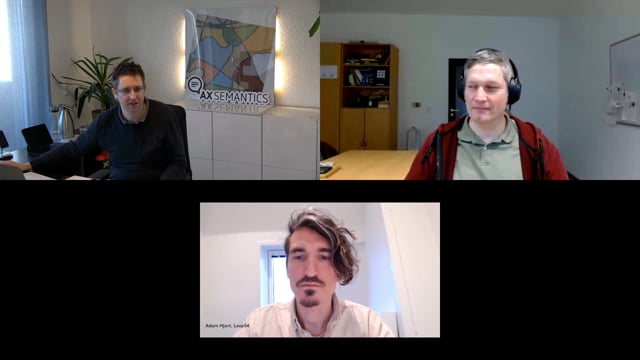
So, thank you everyone for coming here, ähm, to this round table. We have something around an hour or something, ähm, to discuss, äh, if we get more questions or something. We'll see where we end up in terms of timing. But, äh, so let's get started. My name is Robert. I'm from AX Semantics, co-founder and managing director and, äh, happy to be here, äh, and discuss, äh, with you actually, or like you to speak a little bit about, äh, Personalisation, online retail, what's happening, how personalisation can actually help people and help your business grow. Um, I think that's the, that's the topic for today, ähm, and I'll leave it for you to, to you both to fill that. I have some talking points to push you through. But, äh, before that, thank you, Stefan. Thank you, Adam, for joining. Äh, and, äh, I'll give you a few seconds to present yourself. So, Stefan, äh, you have 30 seconds. Who are you? What are you doing here? (lachen). Yeah. Good morning. My name is, äh, Stefan. I'm, äh, Owner and, ähm, the CEO of the Company of Metafexhuger, based in Emmerich, which is very close to the Dutch border. Ähm, we are not mainly an online, ähm, shop, but this is, äh, actually our catalog. So, ähm, that's why we're interested in this, but we're using the tax optimization and, ähm, we are ... Our main products are from metrology, we're doing cutting tools and all that. So the, the, äh, opponents we are facing are, ähm, Würth Group and, ähm, Hofmanngroup. All that, the big players in Germany, we're trying to fight for the right word, but we're trying to, to be good opponents for them, trying to get their business to us. (kichern) Cool. Thanks. So thanks for coming. Äh, ähm, one thing, and that's especially I want to, to stress for everyone that, äh, is here on the OINKB and, and watches these sessions and the others and then goes back to the, äh, office desk, äh, probably tomorrow or tonight or whatever, ähm, and then thinks: "Okay, this is all cool, but we don't have the manpower or personpower to do that." So, ähm, Stefan, how big is your whole team, including all the online sales that you're doing? How many people are you? Ähm, we are a very small team of four people and, ähm, one of them is half-time. So actually he is three full-time. Two of them are in, ähm, doing the, the sales from the purchase to the shipment and two of us, so me and, ähm, the half-time job is doing all the online business. So setting up all the systems and doing the text automation and everything- Yeah. -so- And you do Omni Channel and everything. And we're doing Omni Channel. We're trying to be very good with the small team. Everything's possible. Nice. Good. Now, Adam. So, my name is Adam York. It's, ähm, pretty much impossible to pronounce in English. It means dear in Swedish. Äh, I am from Loop54. (niesendes) Here is an algorithm we create. We've created an proprietary algorithm for, ähm, for e-commerce actors. So what we do is we provide, ähm, the best search results, ähm, when you're searching on site, ähm, but also we do recommendations, so complementary products and so on. And also we do navigation on e-commerce sites. Me, myself, I've been working within SAS for the past ten years. So software as a service. And I'm speaking quite a lot about AI and especially it's, it's very nice to hear, Stefan, that you're, you're such a small team and, and you can come a long way by using automation and AI to simplify your daily life. And that's basically what we do. Ähm, our clients do not really need to, ähm, manually handle search results or merchandise results, but it's really based on what clients or, or sessions actually are interested in. So, and what we do is in, in essence, we increase conversion rate and, and, and bottom line profit really. Mhm. That's also a very interesting thing. They are, ähm, using say not your solution, but we're using something different, ähm, a website and it's just working very ni-, (räuspert) sorry, very nicely. Cool. And just in time we have Bernd. Hi, can you hear? No, we can't hear you. No. Not yet, but we can see you. So that's, äh, probably switch the microphone. Something. No? Can you hear us? No. No, we can't hear you as well. Not working. Sign Language 101. (lachen) (lacht) We need this, this speaker cards, right? To, to like, ähm... And I have a chat message. Okay. Okay, it's actually, ähm, the organizers are, they had zu set up something für Bernd. So, ähm, Zugriff erlauben für das Mikrofon Band. Ähm, you need- (spricht ein anderes Wort) There's, ähm, there's a box on the bottom of the browser that says, you need to give access to the microphone, says the organizing team here.Okay. Okay. In the meantime while bounce sets this up. Don't keep the audience waiting too much. We can introduce him later. But so open question for you both. What's if you look at the landscape of online retailers and online shops of the trends of the last few I mean Corona or Covid obviously, but in terms of what you need to do, what is changing, what is accelerating, what's the main trends that you see that people should have a look at or already, already having a look at so. Maybe I don't go first. If I can go first. Sure. Well, I think for the past two or three years, I think a lot of Ecommerce and retailers have started to understand the importance of personalization and also the importance of, of working with automatic connected processes for, for creating good experiences, good experiences for the users. And I think also with the, with the rise of live shopping and stuff like this, people are really understanding how much an impact virtualization can create. And at the same time, I see a shift also that we have a lot of retailers that are trying to, trying to get instead of I think there was a long time where they're trying to work with best of breed, but today I think a lot of retailers are more interested in getting everything from one platform instead of picking from different platforms. Okay. Yeah. From, from, from the shop side of view. I, I agree with that. What we're facing is not since Corona, a little bit before it started to that we're selling more online. This is one thing more online and I told Adam before that using a similar system as him. So one, the thing is what we're trying to do is using different systems AI for the search. The search is one thing. People need to find the right things on the right spot and the right way. We learned that three years ago. So we're using this since three years and it's giving nice things, nice, nice results. Next thing is that people need to be catched by, I need to start different. We, we, we need as a small company and with a small team, we need to make things different. We don't have a budget to promote, to promote, to send out e-mails every day, to send to all the Google Ads and all that. We're not having this big budget. So we need to try to make things different. And AI and in this case AX Semantics helps us to be different, to set up different texts also for different marketplaces. What Adam said, people like to purchase from one marketplace, just get one invoice from the marketplace and maybe get three or four deliveries from different suppliers. That doesn't matter. This is something we're also facing and we are working on doing that. There's four platforms in Germany for the things we do, what we are going to upload, going step by step. They start to give very nice results. So we're facing the same thing. Online sales are increasing. We are mostly into B2B, but also these sales are increasing and of course, the end user sales are increasing as well, more than the B2B sales. The user experience is we need to improve, of course, on our website, but the user experience is of course the most important thing. And one of them is the search, which is very highly recommended that this is set up nicely. And the other thing is to give the information at the right point, the texts. Okay. I think that is something that I also see and that has risen in important that UX has moved from being like a side business to being one of the main things companies are focusing on today. Like they have set up much bigger teams for the UX. You know, you have someone responsible just for the checkout process, for example. And I don't think we could have this or we didn't have this type of specialized role just a few years ago. And I think like UX has grown from being like someone who's doing this, this thing with UX to something that is probably one of the most important parts of a retailer's everyday work. Yeah, but what I've seen is also that UX in the past, I mean, not from a view of UX expert, but as a structuring in organizations or UX has always been the design thing, right? So they make it pretty. So we think this is the process and then we make it pretty. And I think the shift has been to, okay, we really call it experience. So we design the experience and then make the process to match that experience, right? And of course the product discovery part, search or actually also buying part. So I have this article ID, I just want to go to this article directly to buy it and go through search to make that happen. It's a big, it's one of those examples. We've seen lots of improvements where in the past people have just set up the whatever shop system they had and well, that's it.Äh, most people actually, ähm, stephan, we talked about this yesterday for in channels. Nowadays people actually optimize for each channel because each channel or the, the all website included has a different kind of, of search and how it works and you prioritize differently in, in keywords and stuff like that so. Becau- And the audience is different, so it means different information in the end in the content. Ähm, and, and one thing that, that you mentioned, Stephan, is that you actually try to do more on side and, and bring me the reach without spending lots on ads and, and budget. That's... Did I understand that correctly? Yeah, because we can... We are a small company with a small turnover. It's not that small, but we're good, we're good. The house is warm, everything's good. (lacht) And, ähm, the, ähm, it is... That's, that's a... You need to be a pro doing Google Ads. You need to be, ähm, experienced for the Google Merchant. So this is time and money spending. We don't have that much time. Actually, we should show, should focus on different things, one, one after the other. First step was the, the search, which I find very, very, ähm, important. That was the first step, the search, so that people get the right things from the search, that's the first thing. Then they get into, ähm, the, into the, the product. The second thing was setting up nice texts, prepare the texts and all that. So one after the other. Ähm, so we spent the budgets we have first there, there, there, there, there. This is all we can do. We don't have the big teams, ähm, to, to match all of the needs in one spot. This is, this is the, the main reason why we're doing that, like this. Yeah. So and, äh, the, the, äh, second thing that, that's part of this is actually that, äh, we are not, we are now in this roundtable, obviously talking mostly about the experience on the site itself. Ähm, so we're not talking about increasing reach, ähm, but Adam, we had that when we, when we talked about the, this, äh, yesterday was that in the past people have mostly thought about how to acquire traffic, how to bring it to the website, äh, äh, äh, by organic or, or ads, however invested there. Äh, and, äh, you, you said yesterday that this is, has changed tremendously, the, the focus from just audience, äh, or reach to actually getting something out of that. Yeah, no, I think... I don't think it has changed as much as, as, as much as it should have. Äh, I believe there's a lot of retailers still focusing on the top funnel, you know, acquiring users to the website and that could be through ads, marketing or newsletters and so on. And I think a big focus for almost all retailers today are in this part of the funnel. Whereas I can see, for example, the concept of SEO should... I believe it should be expanded to also site search. So, so having a good site search, for example, is super important. So you're, you're, you're focusing a lot on acquiring the top funnel and then you're focusing a lot less on actually providing the experience for those users to actually make them buy. And I believe that is something that needs to shift quite a lot, ähm, and, and, and search is one part of that, but it could also be how you work with, äh, you know, campaigns, how you work with, äh, fronting products and so on. Yeah, okay. Ähm, and, I mean, what we see, especially with mobile devices actually being the main, äh, äh, usage path or experience path is, I mean, you have limited space, äh, and what we have seen as well as a big trend that actually the UX, the design itself, not the user experience, but design gets kind of standardized. So what options do retailers have to actually distinguish themselves? Well, there's different things, of course, you can do. I think there's a lot of retailers that are focusing on price battles. You know, they are scraping competitors, they are trying to match the price, äh, especially bigger ones, of course. But I think one thing that you really need to do, äh, and that one... We have a Swedish retailer called Serviera that was pretty recently acquired and they grew from 90 to 500 Swedish crowns. So that's around nine to 50 million Euros in revenue in 18 months during Corona. And they even increased their, äh, äh, sales in physical stores with 25% during this period, during Corona, which was pretty much unprecedented in the Nordic region, I would say, because, you know, there's a lot of... There hasn't been that many lockdowns in Sweden, for example, but of course, there are a lot fewer people moving in the physical world than it was pre-Corona. And what they did was actually focusing more on, like, what type of assortment are people actually interested in buying. So of course they're working with all the pricing strategies and stuff like that, but I think they had a lot more focus on actual assortment and what, how big is their assortment, which products are people actually searching for. Because that is a type of information that, that a lot of retailers are missing out on. So what are people actually searching for when they are on your site? Äh, when I'm talking to, you know...I don't know how to say it in english, but people like procurers for retailers. They do not even know what people are searching on site. They know what people are searching on competitor sites, but often they have little to know knowledge of what people are actually searching on their own site. And I think those things are super interesting and valuable to actually know what type of assortment you should have. Ja, I agree with that 100%. We're getting these results also from our system and we can change the search and adjust the search for these things. Und es ist working 100%. Yeah. Yeah. And that's I mean, in a digital world, that's easy information to get actually right. So I mean, it's not, maybe not easy to integrate into the process, but it's something that's actually there because it's happening on your side. It's not a physical store. You have to do to walk through a lot of hoops to get the information what people are actually looking for, that is interesting, so in terms of competition because you mentioned they know what they're looking for. What are people in online retailers, what they're looking for at competitions. So Stefan, if you look at your competition, what's the stuff that you watch out for? What are they doing that you don't do and vice versa? What they don't do is text authorization yet all the big players we're facing are not doing that. Also I don't feel anybody who's doing that. We do, we do. Wait a second show. Hallo Burns. Hi, I think your microphone is working. I think it's working now. I'm so sorry. I had big trouble with my laptop. I think you have an echo. I think you have an echo that happened to me earlier. Do you have a second tab open where the session is also in. Because I can. Actually. I try to solve. Okay, let's let's see. Okay. Okay. So what we are doing is what you know, we're doing the personalization of the content. We're doing the text optimization. This is no one else in our field is doing that yet. So we stepping, we're doing the first steps here. I know that nobody's doing that because everybody's the people I'm talking to in this field are a little bit afraid of the team, like what we have. The team is not big enough. The time and the money for that. So we're doing this and the competitors also, of course, the big players. What they do is they spend a lot of money into the newsletter System what we not have yet spending a lot of money to the ads, but they also have is they have sales representatives running around like the group. They have 6000 people around the ball going to the customers of course, we also go to the customers, but there's no need to go to the customers all the time. We go there and we like we like to do that because you do not learn that much when you're back home. You need you. You learn from the people from from from the from the customers when you're there. So there and also one more difference is what they have. They have these big catalogs with thousands of pages of all the product they have. What would we do? Different is we just have a leaflet, a 30 page leaflet, but we can update every three months what we do and this is going to the customers, so we can the reaction we can have on the market. So if there's any news in the market, we can have them on on our leaflet very early. Okay. The big ones, they cannot do that. So there's a lot of difference between the big, the big players and us. Okay. The way we. Good. So cool. Thanks for for coming back and fixing this. I know that it's always hard if you're on timetable, a new tool and stuff like that. So thanks for not table flipping. Willkommen beim Vermerten von Salute. Thank you very much and again apologies for being late and having lovely troubles with my laptop. We'll bring you up to speed in a few seconds. That's totally fine. So 32nd introduction. Who are you? What are you doing? What are you doing with online retailers? Because I think some people might even not know you yet, which is surprising. I'm pretty sure many people don't know me and many people don't know Soluta. But I think many people know Billy Gad, one of the largest Price comparison Plattforms still in Germany. One of the pure players that are still on the market. I'm one of the two managing directors of Salute. I'm there now for nearly four years and what we went through the last three and a half years was a restructuring and turnaround story, let's say, and we moved on from the being a pure price comparison platform. Billiger de the only brand known outside to salute, offering now various services around reach and conversion for our customers. We've got currently on our platform Billiger de which is the best known one from our brands about 60 million offers online. We've got around 100.000 price descriptions, product descriptions online, mostly done with sematics, which we're using now for seven years nearly. And we also have about 300.000 visits, unique visits per month on our website. So we are very much focused on reaching the customers and providing value for the customer. So we are very much focused on reaching the customers and providing value for the customer and providing value for the customers and providing value for the customers.Er working on optimizing the customer experience at billiger.de which is our brand to the outside to the B2C customer let say and we gained back trust over the last three years which was burned let's say in the past which greater brought us in difficult in the difficult financial situation and we are now back on track and we are now moving on to develop new services. Cool so and you i mean in terms of what you are doing from the customer tell me if I bin wrong so you are basically in this round here on the table. You are the one that brings traffic and reach to the online retailers right so people go on the product comparison site and then they buy ads for example Stefan's online shop right. In the ideal world yes. In the ideal world yes okay and you recently also acquired expert so you also have that combination of organic traffic and reach and also ad spending. Correct so our focus is was something we need to get clear also inside our company in our heads is we do B2B business and the channel billiger.de is one B2C channel to create a reach and conversion. We also do performance marketing so full managed service in the area of google pla microsoft ads and because I'm convinced that marketplaces will grow in the next couple of years significantly we also entered into expert as a shareholder to also offer our customers a way to optimize their ad spendings on these platforms. Currently we have amazon and ebay but a third one is going to come in twenty twenty two okay. Good so the question I put up to Stephan and Adam at the beginning was I will give you the chance to go there as well what you see are the main trends for online retailers or changing in the landscape over the few years except the corona and covid thing. I think one of the major changes is that I'm seeing for the last lets say one and a half two years a significant change in the online market by upcoming online markets more and more which large marketing budgets. So from my point of view, it is getting more and more important to seriously think about being active on certain marketplaces where it fits. Because I I'm hundred percent sure that just betting on google is for the future not enough in my opinion. I we've seen a good increase in the visibility on on billiger.de as well but the organic reach that you create with the same amount of index is not the same as we had it three or four years ago. So there is a change and we all depend on google. So I think there is going to be a change for sure. You need to check as well the provision you have to pay on the marketplace but I think in the long run if this is the way it's going to develop it's the only way to survive as a online shop for sure you need to have the online shop as such as well with a good customer experience but I think it's a good and a very good additional way to create revenue and profit if you do it clever because also what I just read yesterday bing from Microsoft is testing now in the US a marketplace solution or shopping solution. Google is doing the same in France and the US and I'm hundred percent sure it's going to come and then it will get even worse for online shops to reach customers in combination also to the invest you need to reach the right number of customers. So that's my personal opinion that there is going to be a big change in the next two three years. Ja, ja und Stefan, you were you were actively nodding so you agree. Yes, I agree one hundred percent with that with us it's a little bit different because we are more B2B than B2C but that's the same as mentioned before that's the same thing there is marketplaces we are attending to we are going to agree one hundred percent that this will change a lot in the next two three years. Ja and also i think there is i mean B2B ist always just a few years behind the B2C. We see this consumerization of of B2B. Not us, not us. Front running. We had that you have you have actually customers that pay with PayPal and Klarna and stuff like that which is yeah which is just natural I mean that's how we what we do in our daily life that's what we bring to the office especially since the the office actually came come home färtig go. You also just mentioned Klarna which is going to be a player everybody underestimates I think at the moment they just bought Pricerunner one of our competitors in Scandinavia for three hundred million Euros which is amazing this is an amazing price but looking at their strategy they are becoming also a marketplace you can do it on the super Klarna app the shopping solution in the in the short run it's going to come and they are big player nearly every online shop offers Klarna so what is the natural next step.So basically they start to own their customer relationship from the back, from the payment and refund and go to the front. I mean amazon also did the other way mit offering amazon payments for people on their shops to extend their trust. So now we are at the point that We covered that in the beginning. Design of online shops more and more gets the same. Your USPs gets down to the actual customer experience and user experience as well, but also the customer experience. I think, Adam, that was your pet peeve in a positive way. And now we have all these players and channels and more and more players. So how do you make sure that the online retailers that you have still have the relationship with the user? What's your tool with the customer? You mean the online shop, its B2C customer? Yeah. In the long run, I think it's going to be extremely difficult to keep a good relationship to a customer, because when you think to the end what Klarna is doing, they're becoming the new gatekeeper in the market because they're coming from the other end. They have all the data and they take more and more from your customer data to themselves. You are more and more out of the game. And I think it will not be the key in the future anymore because we already learned that sticking to one shop is not the reality anymore. I'm not going to a shop anymore. I'm going to a shop that offers a good experience, that has big trust in the market, where I can be sure to get the stuff I'm ordering, and tomorrow it's going to be the next one. There is no personal relation. I think maybe there is a chance with regards to the cities when you more and more combine online and offline shopping experience that then can reclaim the customers within the cities having the shopping experience by touching stuff and so on, but having also the luxury of the comfort of online shopping. But this is a long way and no single shop can do that itself. It needs to be the city, the politicians, plus the online community. Since we have that, I think we covered the basics. Now we have this. Most people start optimizing the top of the funnel only, and competition only by USP, only doing it by price is something that eats your margins as does spending lots on ads. That's a different part of the calculation, but same problem. You have more and more channels and marketplaces to fulfill. How do people actually do that? For those that didn't join in the beginning, Stephan, you said you have one and a half people working on the online. A question also to the others, what are options for online retailers to actually do all this stuff that needs to be done? What's the take? For our clients, I would say, is working with automation and AI to actually create experiences that are based on personal preferences, what they've been previously buying, price sensitivity, brands. Basically, resorting and reordering products based on what they are doing during this current session. Are they looking for TV? Are they looking for a smartphone? And making it much more accessible for the users to make them convert. I think that is super important. And doing it in an automated fashion. I think there's been a lot of reliance on visual merchandising. It's a legacy, I would say, from the physical store that, yeah, we have to do visual merchandising. And I agree, I totally agree. You have to do additional merchandising, but you should do it on a one-to-one scale because that's what you can do on an online operation, and you cannot do that in a physical store. And I believe that needs to be applied to more businesses or even B2B businesses. I also think you need to use more service providers like, let's say, a channel pilot that have the API and the access to different places where you can sell your stuff. Let's make it generic. Alone, no chance. Too much development costs, too much stuff costs that would arise. Automated, use service partners and look at your shop and your offers, what fits to the right place where you want to sell it to find the audience you need. That's correct. Automatization as much as possible. But for the channel pilot and all that, for B2B, this is not really possible. Because if you look at Bukato, if you look at Meplato, what we're using Tulanea, all these guys, they're not connected to these platforms, especially Bukato, they're using the BMA card. So you need to prepare every time a new BMA card system for them, which is disgusting. I hate doing that, to be honest. But we're doing that and we're doing business to them and it's worth it. But we cannot yet, we cannot use a squeeze channel management system. Wir haben zu viel Marketplaces zu serven.This is what we are facing here. But that's probably just an evolution and product evolution thing of tools like Channel Pilot or something like that. That's right, but it's, it's the, these, these, um, these marketplaces are not that popular yet. These are more into B2B business. Um, they are not for B2C business yet, so it it's not too popular to integrate it into these, uh, channel management systems, yet. It might change, in the future, but not yet. Not yet. (lacht) It's more, it's more easy to place it on or something else, or Amazon. That's, that's quite, that's quite easy. But what we are doing- Ja. ... but we are doing, it's not, it's not that easy. Okay. So, so bringing that, that topic around to the round table tagline, um, what type of, so we need automated tools, uh, and automation of processes. We need something that actually does not just bring reach, but also conversions. So in terms of personalization, what could be, what are potential benefits, or what, no, potential is the wrong word, but what are the benefits that, for example, your clients are seeing, Adam? I mean, you do personalisation, curation, stuff like that, so maybe give us an overview, what are you actually bringing to clients- So- ... and what they are doing in general? Yeah. No, I think, uh, well, what it does in, uh, in the end is increasing conversions and increasing, uh, average order value, for example. Um, but it also increases the user experience, I would say, you know, you're, you're getting the right ... If you're searching, you'll find an actual product you want, for example. Um, so I think that is ... And in terms of, of revenue, I think on average Personalisation, so we have clients who are using Personalisation, we have clients not using Personalisation. And we can say on average the, the per-session value increases with around 5%. And this really differs depending on what type of store it is. For example, fast moving consumer goods where you know you buy the same item over and over again, they have a much better re- e- effect of, for example, preferences, brands of milk ............................, for example, compared to products where you buy, let's say, uh, something that you really buy, sell of cars, (lacht) car retailers. I don't think we, do have that many car, but we do have like machines and stuff that you buy maybe once a year, once every two years. Of course, preferences are less, uh, are, are not as important for, for those products, but often. But around 5%, but we've seen numbers such as 15% per-session value increase. Um, we did a really big, uh, test just before the summer for a very big retailer in the Nordic XXL, where we increased their procession value by just reordering their ... wenn people are navigating through their categories we increased their precession value with 11% compared to the previous solution. Right. Uh, yeah, so that's, and, and in, in round figures there, that was three million euros increase in revenue per month. So that's- (lacht) ... what I told them was basically like, you haven't done an investment ever on your e-commerce operation that is given these type of effects. That, that's true, but that also, uh, needs to make sure that you are able to actually prove that the numbers, right? I mean that's, uh- Yeah. Yeah, we do a lot of A/B tests, so splitting traffic 50/50, showing the results. So that's, ja. Ja, how, what would you say, what kind of, uh, data or, or data awareness are at your customers? Uh, are they aware of the information and data and metrics that they should have a look at? Or do they just install all the tracking tools and then never interpret them? So I think there's ... I love and hate Google Analytics at the same time. I love it for everybody's using it's universal. I hate it for not being fast enough for many operations unless you have 360, which not all of our clients has. Um, but one thing that's super good with Google Analytics is that you can analyze basically everything. If you have set it up correctly to track inside search, if you have enhanced e-commerce and so on. And I think no, most of our clients have no idea how to analyse numbers or not most, but many of our clients have a lot of problems of actually understanding. Uh, so and that's one thing that we need to do as, just as a provider, we need to convey and, and show what the actual numbers are and how it actually, eh, affects the bottom line. But no, this is not often understood, eh, automatically, unless they have a very big team doing analytics. Ja, Stefan, von, vom other side. Are you, would you say you are data aware about your business in online? I'm trying to understand the numbers we get. There is a few sources we get it from, one is Analytics. Um, to be honest, I do not understand all of it. Um, but this is related to the team. Then we get the information from Doofinder, which is the product we're using, so we can analyse these things. Uh, the, the in-search, uh, on-site, um, and, and can make adjustments from that. And of course, we're using the metrics of, uh, AX Semantics, um, to find out, uh, what the personalisation gives in numbers. Und, ähm, ja.Numbers are important to make the research, but it's not all of it into the feeling. Ja, das ist true. But ah ja, es steht us to try to be a numbers guy or person as well. So but there is so much out there and ich actually don't think google analytics is actually of not logged in into a year or something, because I don't understand it any more. Of he needs it. Nicht mehr nice for it. Yeah, if it's set up nicely you get everything out of it. You want. To how would you say are your clients in terms of numbers? I mean expert obviously is like the number one number tool, but are they actually looking at that? Are they interpreting them, right? I know you don't need to Jeds the tool who's doing that. It's machine is based on machine learning, so from that end experts doing the job at the end. Yes, the customer needs to look at his data. Does the attributed sale grow due to the ad spend that you have and the optimized campaign? That's the job he needs to do. And therefore we offer a dashboard, so that he can easily analyze it. It's not as complicated as Google Analytics. With regards to the more than 2000 customers we have, I would say many have one key issue that there is no team behind the shop. So they can't interpret correctly Google Analytics, if they use it at all because due to GDRP many took it away. We also deleted Google Analytics from our website. We using Conda now, but yeah that's the key problem. Even if you interpreted what are you doing with the data? Knowing something doesn't mean there is there is a decision or an action behind it. If you just measure, read and say oh bad data, but you're not taking any decisions out of it, it's not worth looking at. It's not good. And I think that's the key issue. Often not having the resources and then seeing something but not doing anything against it or doing ab tests or whatever to really taking the time to increase the success here by using it. Okay, and if you look at the at your most successful customers what are they doing how are they doing? It especially since you mentioned execution is actually the key problem that most people struggle with. But how do those that are successful are solving this? Due to the fact that we are just offering the platform where they can list their offers. So the customer other the b two C customer can then see it and buy it were not in that much how they deal with their online shops as such, but working with the shop managers normally you see the big ones, the larger ones that they are very deep into the details that they know exactly in which channel they have what conversion, how it works, how many clicks you need and so on. So they have normally what I understood a team behind it. So they're not by doing it by themselves. Often there are data analysts and the larger they are, the more successful they are by using these kind of teams and then interpreting them and doing a B. Tests by trying new stuff to increase the customer experience here. Okay. I totally agree. I think the clients we have that are the most successful and improving the most over time is the ones that are doing hypothesis testing by with a B tests. I think that's one of the key things. Understanding that you know, if you're doing a change to your ecommerce operation, especially if you're doing bigger changes, you need to test it. But there's a lot of actors out there. They are changing shop system. They're changing everything without even on gut feeling. And I think that is and will change a lot. And the ones that are successful are the ones that are actually testing this before they implement it. Okay, so one hint for the audience. Feel free to use the chat for any questions that you might have to any of us for. I repeat that over the next few minutes. So just writing in the chat, I'll read it out and make sure that it gets answered somehow. But kind of like when we're nearing the end of the session, there's still time. So in terms of personalization, Adam, you've seen a lot of stuff working over the last years. What's coming now? What is the one, two, three things that people are looking at in terms of personalization? I think it's I think integrations will become more important. So you know, making newsletter personalized on a one to one level for example, but also making personalization and integrating for example point of sale system. So you can actually base preferences on physical sales. And these type of integrations I think will grow quite a lot looking forward. Okay, bernd, what's your take on personalization? First of all, you need to deal with what does personalization mean? It doesn't mean that you need to individualize it hundred percent, but using the various channels to communicate with the customer by using push newsletters or being able to offer you a personalized shop starting page for landing page. So using the various technologies you have to give the customer the good experience when he's going to your shop. Und.In this small is it's easy to be bold. That's the first impulse and not reading a long story or doing checks. Is there a shop which offers more cheap? No, it needs to be fancy, it needs to be easy to be checked out and that's it. That's my experience with my little ones. (lacht) So, so, wenn I was starting with computers, we always tested out with the elder ones, so the famous mom checks. So now we are looking at the little ones, but I get that. Ja. (lacht) Ähm, so, so, I agree, I agree. I think one of the most important things about personalization is something that you shouldn't, should not notice it, because then it might also feel weird. I think that's, that's in the past, we've always, I think it's probably a 20-year, 15-year-old example with that Amazon newsletter that you get when you buy a washing machine, that two days later, you get other washing machines or something like that. So that's the ... But I think we've come a long way now. Ähm, ähm, and you, Stefan, I mean, you have your experience with personalization as well. Ja, ich bin mit Bernd. It's, it's, you don't have to make it too much. Personalisation is a nice thing, but in the end, it's, it's ... Because the caliper is not looking fancy, but without this, we have the shortcut. You see the picture, a little bit of text technical information, and then it's the buying button. And this is one of the things, and the other thing is, we do not buy a watching machine, get two days later the newsletter of the other watching machine, but send them a "Boss, you bought a microscope, but for a microscope, you need to have nice lights, which you didn't purchase yet." This is some personalisation which needs to be done, but we of course also do, but not to make it too much. So get what we're doing with AX is not focused on the name. So "Hi, Stefan, you're back again. Purchase this one," and all that. Aber was wir tun, ist: „Okay, du bist das erste Mal hier. Es ist schön, dich hier zu haben." Give them some information, some personal information. Du bist hier, alle anderen 30.000 Kunden haben auch schon hier gewesen. Sie sind mit dem Ergebnis meistens auch zufrieden und ähm probieren es aus. Und das nächste Mal, wenn sie kommen: "Hey, dass es wieder du bist." Aber of course wir sagen nicht, dass du wieder du bist. Wir geben einen Text, so wir haben ein, some kind of personalisation. Es ist nicht zu fokussiert auf die Person. Ich verstehe es wie Bernd sagt. Sie schauen nicht zu sehr auf die Personalisierung. Okay. Aber du benutzt es immer als Differentiator apart with the, against your competition, right? Jup, nobody else is doing that. (lacht) Okay. I think it's, I think it's interesting, you know, taking the ... I, I don't think it's that black and white, you know, personalisation, no personalisation. There's lots of different levels here. And I think it's also interesting, you know, what's the actual effect on personalisation rather than, you know, the ... Because there's a lot of gut feeling, yeah, we don't need personalisation. It doesn't have any effect. But that's the good thing with e-commerce. You can measure everything and you can see the actual effect, especially if you have, you know, you can see it in a couple of days, if you have a lot of traffic, for example. So we had, we have had quite a few like big retails they're doing tests. They could see the results in two days. They have a payback for a year. Ja, that's, that's actually- It's important to test also. (lacht) Ja, well, testing it, testing is, is a proof of spending. I mean, if you, if you see return on invest in two days, you don't need to do a POC, you don't need to do an implementation. You just do it and then you can decide actually after that, if you want to spend the next years of that and you know exactly how much budget you can spend on it, right? I mean, this is the, the thing. Und, und, äh, with the, with the, ähm, with the top of the funnel, you always have spending somewhere else, right? You're, you're feeding the money to other people on Amazon ads, whatever. With investment on your side, it's an actual investment. You will keep that for a- Yes. If, if you automated the process. I mean, we've seen that event, you mentioned it, people are not able to execute on the learnings. I mean, that's one of the reasons. If you, if you rely on people to scale, ähm, you have a big investment in front of you, not only in terms of budget, but also personal resources. And for everyone in your audience, I'll stress this tech, I'm sorry for that, but Stefan is doing that. All the stuff that we talked about, multi-channel, channels, and if someone actually has seen a BME cap file ever, you know, how much work that is and how stressful that can be. Das so ... Und that's the 1.5 FTEs, full-time equivalents. So everyone that is in a bigger organisation, you should actually be able to do that out and get the learnings that Adam mentioned, if you see it in two days. Everybody can reach out to me. I will give you unfiltered informations about text automisation. (lacht) Yeah, because, I mean, you're a big fan of automation. Ja? Ja. I mean, that's one of the core- I need to. Yeah. Ich habe noch keine Fragen aus dem Publikum. Dann machen wir jetzt ... Also ich habe hier noch ein bisschen was, was ich euch erzählen kann. Aber ihr könnt jetzt gerne mal die ganze Welt retten.Stefan You want to uap up impressions. The summary from some one tip that people should do mit regards to getting out of the competitive business of online retail or whatever we call it. Don't be afraid to try things out and try to automate as automate make to do automation as much as possible, but not too much. That's actually the main thing. Okay? Und. Ja, I would say the same. You need to clever combine the different channels. That you're using by using CRM or anything or something like that to really being able to personalize but not doing too much and also yeah, give the customer a good experience by using for example tools like AX to give good content, which still is for my age a good good source and then bringing me to the point to buy. But you should not do too much. Keep the balance between cost and profit at the end. Ja. Shameless, shameless plug there go for everyone go to billing at the look at the iPhone seven page. It's my, my pet my best example of building a content automation and look at the content. There's four screen pages on the desktop of content. All the stuff has been automated by the team of company. So all the boxes, all the layout. It's a really, really impressive example of doing that. So Adam, your what should do. If you're not testing start testing now. I think you should also always try to look at. So I hear a lot of companies that they are. Yeah, we have a provider, we're happy. And I think that's that's pretty interesting. You know, we're happy. What does that actually mean? Have you ever tried, you know, have you tried out other companies performance and so on? And often the answer is no. And what we can see, you know, every time we're testing against other competitors and so on, if we're doing a 10% uplift, that's not. And they were happy before. Are they happier now or like I think it's not, it's not a one zero situation, it's not that black and white. I think you should always try to test stuff, always. You know, you should. You should like see if Personalisation does anything, if preferences does anything, if session intent does stuff, if you're changing your autocomplete, how does that affect your website performance and doing this iteratively all the time? I think that is my main takeaway that I believe a lot of companies should do a lot better. 100 % correct, but I'm happy that not everybody is doing that. No. Okay. Thank you all. You free Stefan Adam. I hope it was a nice session. It's always hard with not seeing the audience and not getting any feedback or so, but I've seen that we have a quite stable number of people in the room that stick to the end of this one hour session. So thank you to the audience for listening in. Thank you to all the video viewers in the future. Good show. Will have a look at that future. Thank you and have a nice day. Good bye! Thank you. Thank you very much. By by.
Automatisch erstellt & redaktionell aufbereitet — kann vereinzelt Fehler enthalten.