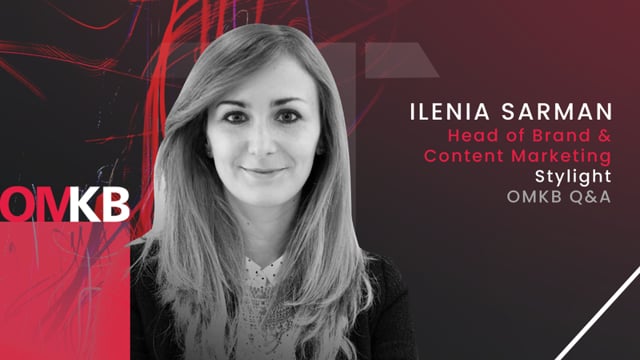
(metallische Musik) So, welcome back. Ähm, schön, dass ihr weiterhin dabei seid und uns über den Tag verteilt die Treue haltet. Ich finde es fantastisch zu sehen. Wir haben tatsächlich die gesamte Zeit im Stream heute, ihr seht das, über fünfhundert Personen zugeschaltet. Das macht natürlich richtig Spaß. Und wir starten jetzt durch in das Mittagsprogramm. Und zwar haben wir den nächsten Vortrag für euch vorbereitet und ich freue mich, dass wir gleich Ilenia Saman begrüßen werden, Head of Brand and Content Marketing von Stylite. Ganz wichtiger Hinweis für euch: Ilenia ist gebürtige Italienerin und wird den Vortrag entsprechend gleich vollständig auf Englisch halten. Ich gehe aber davon aus, dass das für einen Großteil der Zuseherinnen und Zuseher kein Problem sein wird. Parallel dazu möchte ich noch einmal kurz hinweisen auf unsere Session-Bühne. Ihr wisst, dass wir auf unserem zweiten Track eben weitere Themenkomplexe heute mit abbilden über den gesamten Tag. Da möchte ich euch den Vortrag von Timo Bernsmann empfehlen, von Finch, der seit dreizehn Uhr unterwegs ist, rund das Thema E-Commerce und wie man sich dort im Bereich auf das ja jetzt anstehende, normalerweise umsatzstärkste Quartal aller Zeiten idealerweise vorbereitet. Aber kommen wir einmal zurück zu Ilenia. Ilenia, wie gerade schon gesagt hat, Head of Brand und Content Marketing bei Stylite. Wer Stylite von euch noch nicht kennt, Stylite ist eines der größten Fashion-und Shoppingportale überhaupt, mittlerweile weltweit, ist eine wirklich erfolgreiche Gründungsgeschichte aus München. Das heißt, ein deutsches Unternehmen, was das geschafft hat, tatsächlich über auf der einen Seite eine große redaktionelle und Content-Stärken, auf der anderen Seite eben fantastische Auswahl und kuratierte Selektion von unterschiedlichen Brands und Fashion Items tatsächlich in diesem doch sehr umkämpften Markt Fashion E-Commerce-Fuß zu fassen und sich dort erfolgreich zu platzieren. Und Ilenia wird in ihrem Vortrag leicht darauf eingehen, wie Data-driven Marketing und Content Marketing idealerweise in Kombination miteinander eingesetzt werden können, um tatsächlich in dieser doch herausforderenden Content-Site, äh, das eigene Business, die eigene Sichtbarkeit und entsprechend auch den eigenen Organic Traffic nach oben zu korridieren. Das heißt, wir haben jetzt einen wirklichen Deep Dive im digitalen Marketing-Sinne vor mir. Ich freue mich ganz besonders darauf. Der Vortragtitel, Titel von Ilenia verspricht es ja schon: Without data, you're just another content that doesn't get links. In diesem Sinne switche ich jetzt einmal auf Englisch und begrüße Ilenia Sahmann. Hello Ilenia, welcome to OMKB. I hope you are able to hear and see me. Hallo everyone. Hi, how are you doing? I'm really good. I'm really good beside the really not nice weather in Munich, but rather than that, it's really good. (lacht) So you're located in Munich today? Yes, I am. I'm always located in Munich. Yes. We have a headquarter here. Okay, I'm very much looking forward, ähm, to your talk about, ähm, data-driven marketing and content marketing. Ähm, just as a short introduction: Was ist-- What is your part of responsibility at, äh, Skylight? What's your daily tasks? Ja, so, ähm, I'm in charge of the branded content marketing department, which is basically focused on anything which is organic marketing related, being SEO, of course, so the more technical side of, äh, SEO, but also content marketing, push marketing, social media, so anything which is not, let's say, paid and performance marketing dr-driven. And this, of course, opens up also to more branding and PR-topics. So it's a pretty broad, let's say, area- It is, it is. -of tasks. Okay, that's, that's a lot of, äh, responsibilities in your department. Ja. (lacht) Ähm, since when are you working for Skylight? And what did you do before Skylight? Ja, so I'm, I've been working at Skyline now for almost six years. Äh, and before that I, äh, was working in Italy. As you mentioned at the beginning, I'm Italian, ähm, and I've done PR, so more traditional than digital PR for about six years. And then I moved here. I first started as a senior PR-Manager. So I kept, let's say, my path, äh, and then I switched more to more technical SEO and content marketing and that's basically the, let's say, the biggest focus that I've had in the past five years, I would say. Okay, ja, thanks. Then we can now step into your, ähm, session. The stage is yours, Ilenia. Have a lot of fun and I'm looking forward to see you again in the questions and answers part. Enjoy. Thank you very much. I'm gonna share my screen quickly. And yes. I think you can see everything. Okay. So, äh, thank you very much again. I think I don't have to introduce myself anymore, so I can go pretty fast, äh, with the very beginning. As we said, the main focus of this, äh, of this presentation that I prepared, is on how you can really use your data to create a content that gets you links, hopefully. If you have an SEO-background, you know exactly what I'm talking about, but also, of course, media coverage. Ähm, what's Skylight? Again, I'm gonna be short here because there was a super good introduction already. Äh, Skylight is the world's leading online search platform for fashion, beauty and design. This means that we basically, äh, show on our platform the products of about one thousand three hundred shops, äh, global shops, so the biggest retailers and monogram stores in the three verticals of fashion, beauty and design. And we offer, we make sure, let's say, that the users who are landing on Skylight find the next purchase that, äh, you know, that they want to, äh, that they want to buy for their, for example, for their own fashion needs. Und, ähm, aber what's on top of it? So, this is the core business that we have, äh, but that's more. So, what am I talking about? I'm talking about twenty-seven million products and twenty-five thousand brands on styler. So it tells a lot about the type of data that we have access to. Sixteen markets, so not only Europe. As we mentioned, we are Munich-based, but we are, äh, present in Europe, North America, Brazil, Australia, ähm, so we have a pretty global overview on the shopping behaviors. And twelve million monthly users, that's the average amount of, let's say, users that visit our pages every month. Average main audiences between twenty-four and, twenty-five and thirty-four years old. That's really important also for you to understand the type of content that we are, äh, that we are producing. So you see all of those numbers and you're probably asking yourself, "Okay, what can we do?" No, what can they do more than their main, let's say, E-Commerce Business? Ähm, I'm gonna bring you a bit back. I'm gonna be fast, so no worries, I'm not gonna, like, talk for twenty minutes about the history, but, ähm, we've been doing Content Marketing at styler for seven years, I would say, almost eight now. And I've been here for a big part of, of this. Ähm, and we really, I've really seen how we move from, like, really rocking it. We were, like, doing great things when it comes to Content Marketing Campaigns. And then we got to the point that it got so hard to get any type of media coverage. Ähm, how did we do it? So in 2014, we've been one of the first, let's say, in-house teams and to roll out a really creative way of building links. Ähm, Link Building again, which is such an important part of anyone who does Content Marketing with an SEO background, is our bread and butter. Ähm, in the past, we used to, you know, track opportunities and events, spend hours in Brainstormings to come up with really creative ideas that would allow us to bring, let's say, to build a Content Marketing Campaign that would also become viral. Äh, this was one of the main goals that we had, not only Link Building, but something that would be, like, newsworthy, but yet easy and catchy, so that we could also catch this social reach, you know. You, I mean, you all come from Marketing, I think, and you know the gold old, old times when you could still try to get organic social reach without paying for it. Ähm, it feels like ages to me because so many things are changed. And, you know, I came from these numbers. Äh, one of our biggest campaigns in 2015 was the so-called Minionistas, fully creative campaign borne on the, let's say, media buzz around the Minion movie, which was launched back then. Seven hundred features on website, fifty-four countries reached and, okay, and what happened now? And then, you know, 2017, things started getting a bit harder. And then in 2018, that was the moment where, you know, I really had to sit down and think, what are we gonna do here? Ähm, we know that Digital Marketing, the Digital Marketing world goes so fast, you think you're doing it right, you think you're rocking it, and then you have to change because something changes and you have to adapt. In 2018, the market was completely hyper saturated. Everyone was doing Infographics. I've done so many Infographics in my life, so not regretting it. Ähm, but so many companies were competing with the same type of content. Native advertising got way bigger. So, you know, publishing houses starting, ah, having, some, like revenue problems with traditional advertising, and they're starting understanding the potential of Content Marketing for a company. Ähm, and then last but really not least, äh, they start to, they're, you know, the SEO knowledge among editorial teams grew more and more. What does it mean? That journalists starting knowing why were you asking for a link? Why do you really want to get coverage about your, äh, your Content Marketing Campaign and you were asking for something in return, like a link? And then at that point, we really had to think, okay, we need to, to change something and we switched completely. And how did we react? We went from that like crazy creative type of content to something that is still super creative, I think, but has something more important behind, which is data. Ähm, in 2019, beginning of 2019, we decided to really lean towards a data-driven and personalized type of content because we really wanted to make sure that we could provide journalists with data, with something that is unique, an insight that they cannot get, they cannot find just googling somewhere. And that's really important because, you know, you might say, well, I don't know, Infographics have, have always been full of numbers, but most of the time they were external numbers because, you know, the content marketing managers, they were doing this great work of like, looking for the most interesting facts to put together in an infographic. Right now, what I'm talking about, we have twelve million monthly users and we want to make sure that we use the deep knowledge of these users to create something that the journalists can integrate in their articles and that's something that they cannot find anywhere else. And that's exactly the direction that we took. Ähm, we used the biggest trends that we had. So twelve million monthly users, as I said. We know exactly which are the brands that they like the most, the products, the market insights. We own market insights, we own the data. We crunch data every day as an E-Commerce company. And on top of it, we have fashion and beauty and design knowledge. This is super important for me because I think, ähm, a wrong, äh, perception can be that, oh, you just need data. You know, you need data and that it's enough. N- not really. Especially when you come from industries like ours, you really need the right mix of data knowledge, SEO, content skills, äh, transforecuts in our case, you know, and PR. And there are surely some differences, you know, according to the type of industry you come from. But, you know, if you're thinking of like launching a similar, let's say, new project, I think, I would really suggest you to put together the right team setup, because this is really something I would not compromise on. You really need a mix of data and storytelling to build something like that. Und The project of the World of the Seideninsel. Seideninsel. Sowieso Micro Page Addressing Press Industry expert. Data driven report from shopping. Data in four different languages. Deshalb Market Content to us Germany, Italy und France. Andere We publish on the microsite. First of which the goal of the content ways and mentions publication. To important your company life of the years. Never the less we always need to keep strong thing our Work. Und Background background background background brand awareness. Und der Cover ist happening publications new users as a second step and third super important. Ich finde, dass SEO content marketing and business development in a way have never been closer. So style is a sort of B2B and B2C company in a way. So on one side we have our clients, which are the biggest retailers and mono brand stores in the world. And on the other side our users so facto with this content to position ourselves in the eyes of our clients and potential clients as data driven always up to date company super super strategic for our business development goals. And which type of content we produce. Werts important for me to say that one time of the year thinking of starting something similar that you this time play the same change the focus of think different ways of showing expertise. Company in our case of the page we publish recaps so example so fashion in the past six months that's important, especially in the field background knows that this is everything is like four months ahead looking for the winter boots already in July. Because especially when I really fashion savvy the way before three four months celebrities impact and other really important part no influence. Celebrities. Das ist So much the shopping behaviors of people and so we have some type of reports which we speak about the specific celebrity style and what the brands achieve or he is choosing influence. What people are looking for on our platform and then the fourth part is co branded content. So this type of data content creates a lot of possibilities of collaborating with another company, which maybe offers like a sort of complementary service to what you can offer and then you can merge your data to create something really strong when it comes to content. This really allows us to catch the attention of different publications, which we probably could not attract. If we were only focusing on one type of content and then maybe. Let's say you maybe thinking okay, I'm interested in this is nice, but how do I fit this to my schedule? You know, I have like 50.000 things to do. I'm gonna put together reports every week. Or every two weeks. That's the same for us and that's also why we decided, okay, we know that building big reports takes time. What if you don't have that time? That's why we launched a section which is called Style right now. So especially in the fashion beauty industry, being fast is so important. You know, like the news LifeCycle is so fast, it's like the same as an Instagram story 24 hours and then things are sometimes forgotten. So if you're not fast with like following up on things happening on social media, you might just like miss your train. So on style I know we create really really really tiny reports which are focused most of the time on for example a celebrity in this case that's Meghan Markle is wearing a specific dress of a brand. We give ourselves like about 24 to 48 hours to check okay what's happening on our platform. Are people looking for that specific brand more than before? If so we create a short report and that's exactly what can save you a lot of time. And then we send it out to the media and hopefully we get some nice coverage as the one that you can see here. And so I talked about reports, you know, this is like big focus on let's say bigger things and also proactive things that we produce for the media. But what happens if a media just wants our data for itself? You know, we got to the point after about one year where we said, okay, we strengthen so much the relationship with our media that we got to the point that they were actually asking us, okay, how can I make it work? How can you give me some data? And I mentioned at the beginning, this type of content for me is also personalised content. It might scare you because you might think, okay, that I need to use my time to prepare something and only gives you one media coverage. Yeah, I think it's valuable, to be honest. Sometimes. You know, a journalist is working on an article and they would like to back up this article with data that they don't have.(auf Englisch)Und basically users and die Ärzte mehr Information to the next Luxusbranche. To the neue drei Herren des Trends Because of the World Warz even more than what the world now to benefit from diso of course. But I mentioned that the beginning that one of the reasons why we have to switch strategy was also because the publishing industry was doing great in some cases, you know. So die Lunge Alternative Ways of generating revenue One of des ist definitely affiliate. To a lot of publications now have affiliate links and that's not only for fashion or beauty or design. Ich meine, if you think of Buzzfeed for example, there is like the other affiliate links everywhere. Uh, what if you are giving these magazines not only the information that they can use to build their own articles, but also information, that they can use for data data they can rely on to choose the products that afterwards they can include in their edits or like top ten boots for the spring for example. So it's such a pretty strategic let's say type of content, ai you are giving them that they can also use for several for several purposes themselves. And i denken, dass kann was du business. Das ist Fashion again but lets say you are a travel company you have data about the most search locations for next summer what if you know this data could be interesting for a travel magazine or blog for example who also has affiliate marketing links and who wants to promote specific holiday locations in their content. Das Y realy thing. Das not only one way dat you benific from it but there is like several results that you can get out of it. But so to rap it up I talked a lot about us but how can you do it yourself. Lets say now you are like ja really wanna do it but I have no idea if I have the resources for example. I have four main tips for you and one is data has to be your bread and butter so crunchy dont wait for the others to do it. Ich meine you might think well thank you. Ich meine the whole presentation is about data driven content but what I mean here is that you really have to build a team that has an editorial mindset but also knows how to use data and who wants to use data to package. The right storytelling that they can pitch to journalists get the tools that you need from your data team. Of course I can't know exactly how your companies are structured but if you have a data intelligence team might suggest and get the tools from them learn as much as you can from them but then be independent. Because news hearts so fast that you can't depend on another team who of course has other priorities sometimes and cannot really keep up with your more newsworthy and content related needs. Dann second as I said one doesn't feed them all. Und was ich meine ist das also when you prepare one data driven content always have to think of different angles. Es ist bei der Beginning. I come from a PR background and that's one of the gold PR rules. If my former boss no my former boss would have never let me leave the office without knowing that I had I don't know three four different angles to pitch the news about the next news about my clients that I have to present to the journalist the day after its so important to try to make sure that you present the news in different ways so that you can open up to. So many more publications. Of course that you can outreach to then third one as I said you have zu be fast you always have to be on top of the news that's why you need people who really know the topic they are curious about the topic and they are just not there opening up a chart and checking okay whats actually trendy now you also have what you also have to know beforehand, what's trendy and then also go and look for the data because you really have to be fast in it. Und dann The last thing is build trust and never, never, never break it. So if you have a bit of like a PR background, you would know that navigating the newsrooms and also like dealing with influencers you know its really challenging. Sometimes it takes time for a brand for a Marketing team to build that trust and journalists are looking for data. They can rely on data which is trustworthy. The moment you give them something you give them a piece of content which is backed up with data they trust that that data is reliable because then they use it in their own content and they take the responsibility for it in a way. So what I want to say is that don't break this trust just for the sake of one additional media coverage. If you don't have that data, you just don't have it. Be honest, be transparent, because you really don't want to undermine all of the work that you've done with something that is not accurate and. Ich denke, das es from my side. Thank you very much for listening and I hope it was interesting for you. I know it was lunchtime so I hope you could keep up with me during your lunch break probably. Yes. Lenia, thanks a lot. Thank you very much for this. Really interesting. And the deep dive into your data driven content marketing strategy. Really impressive to see how you analyse data, how you build content relying on data and how you are able to distribute this content together with your press partners and also use it on your platform to enhance your product content and to drive more sales in the end. So this is kind of real impressive Framework, that you have built together with your team. Thank you. Yes, I can, Ilenia, I can definitely say that there, there has been a lot of people listening to your, uhm, to your session. Es ist some questions in our chat and I would like to get through some of the questions that we have. First one of my colleagues, Melinda is asking, uhm, how do you define, Ilenia, which individual, individual template is worth creating content for? So how do you define which target audience is important enough to create individual content? Ist this based on search volume and user questions on other data indicators? What can you tell us about this? Yeah, so that's a really good question. Uhm, when it comes to, let's say, coming up with ideas for the insights report that we produced, we, uh, always mix, uh, two sides. So of course, as I said, this is an SEO team project. So looking for search volume, for keywords, for what are people looking for is definitely one of the most important things. If we realize that a lot of people are looking for, for example, specific trends for the next season, for, for example, which are the most, uh, emerging, uh, sustainable brands, for example, this is a big topic now, of course, sustainability in fashion, in beauty products. We use, we use the search volume, so, uhm, a lot to define if a topic is strong enough for us, because as I said at the beginning, we also want to make sure that our pages are gonna get, of course, it takes time because that's what it is with organic traffic, but we also want our pages to become an organic source, of course. So the more we focus on search volume and on keywords, uh, the more we can try to also catch the attention of these users who maybe are not, let's say, the press that we outreach to, uh, naturally. On the other side though, uh, I always keep, uh, a big, let's say, eye on, you know, on what's, what's important for media. So we have to always keep in mind that not everything is SEO driven. Also what people are looking for, uh, on Google doesn't necessarily mean that, you know, that it doesn't necessarily, let's say, match what a magazine would like to talk about. So having a really deep knowledge of what each magazine wants, how do they tackle topics, which type of, you know, approach do they like? Do they like rankings? Do they like only to talk about celebrities is super important because at the end of the day, our goal is to reach something on those publications and, you know, it might be that there's huge search volume about something, but if those publications don't like the content then we're not gonna make it work. Okay, thanks for answering the question. One more from Axel, Axel Metayer, who is, uh, working in the gambling business industry. So some kind of change to your fashion site. He's asking how many people have been involved in the creation of your insights microsite? And do you have any recommendations for someone starting brand new in this topic who wants to build it as well as you guys did? Yeah, so I think we hear we are kind of like champions and like skating things without having external support. So the team is currently, oh, I'm sorry, I lost my airport. No problem. Can you hear me? Yes I can. Yes I can. (lacht) Um, the team is currently made of four content marketing managers, each of them in charge of specific markets, and then we built everything internally also when it comes to the microsite, we have a great, uh, designer, lead designer, who also has a, let's say, backhand, background. So she builds the pages and she improves them basically. We have of course like so many goals behind those pages as I said organic traffic. So, my suggestion would be to start, you know, not too complex. At the very beginning I had like so many ideas in mind and I wanted everything to happen the moment we launched. You don't need huge things to launch, just structure the basic, start with a couple of reports and then let's say adapt your strategy according to which are the results. Um, one good thing is that I can suggest is that you can really scale it up, um, for different languages. So we launched four languages at the same time. We didn't start with one because it's literally the microsite is a copy for each, for each language. We anyways though, and this is a suggestion that I can give, localize your approach. So the fact that the pages are, let's say, a copy of one of the other doesn't mean that everything is the same, because there's the type of content that doesn't work for some countries, there's a type of, yeah, information that is not needed for the US market, but it's needed for Germany, for example. Um, but yeah, so everything is done internally, um, and you can really scale it, uh, if you want. Okay, and when it comes to you just dropping some of your markets and you have a huge international approach at Styleit. So what is your biggest challenge in being international in this content marketing approach? What is your, what daily problems are you facing when it comes to different international awarenesses, different, different international trends, maybe what can you tell us about this? Yeah, so one interesting thing that I can say is that, um, it's always, let's say, surprising to see how for a lot of markets having a global approach works perfectly. So at the very beginning, we thought we always had to have, you know, local data for Germany, local data for Italy, that Italian journalists would only be interested in Italian data. That's not really true, because in the end we have, you know, the, um, the trends and like the big, uh, events are impacting so much fashion and beauty. ... uh, almost in the same way. On the other side, uhm, the differences that we see, uhm, are, let's say, that you should read, there's like, the US-Market is way more sensitive on some topics, and it's way more, in a way advanced. Uh, for example when it comes to diversity and inclusivity in fashion. That's like a big, big, big topic everywhere in the world, luckily in the past years it's becoming bigger and bigger. But the US-Market is always like way ahead. So that's the market where we have to be even more extra careful with the content that we produce, because the level of sensitivity is higher than what we have in, in Europe. At least that's my perception. Okay. Thanks. Uhm, one more question, uhm, is, you're coming out of the sale perspective on building content, and you're of course having some kind of content marketing machine when it comes to, uhm, your, your speed of delivering content, and, uhm, your contact to press relations, to the magazine-relations, building links for you guys taking your high-quality content in their magazines and press publications. Do you enhance this strategy also with advertising, like native advertising parts, or is this, uhm, a SEO-content strategy only? No, so we also have, uhm, a native advertising packages here, so they are never, never, never connected to the insights-report, like reports and anything which is, let's say, which has a PR- and a link-building-focus, it's completely organic. 'Cause I think this is super important to make sure that, again, you build your trust, nothing has, like, a business, uh, reason behind. So that's like for me, it's a no-go. Everything which is SEO- and link-building-related and for press stays completely organic. When it comes to shoppable content, which is, was what I showed before- Ja. ... what I sh-showed before, uh, we definitely have, uh, in some cases some like, uh, packages, native advertising packages, the Business-Development-Team internally, uhm, let's say, uh, has offers this as an additional, as an add-on to our clients. Maybe they are like, you know, there is a shop which is present launching a new collection, and they really want to, uh, you know, get additional visibility to the one that they normally get. Then we have several options for them, and I have to say that this is like a big, big, uh, strength that we built in the past to years. It took a while, because first of all you need to strengthen your shoppable content knowledge. You need to know which type of content works, what the users are reading, what the users are interacting with the most. And then you have the strength to say, well, now I know, now I'm able to sell this to, to, to partners, because I need to deliver, you know. The moment you sell something, you need to make sure that you deliver. Mhm. So, ja. So, but it's definitely, to me it's definitely split. Okay. There's no way we have like commercial agreements with the reports that we produce. Okay. One more qu-question regarding your strategy in distributing content. You have been talking about awareness, uhm, awareness on the customer purchase way, on the way to the purchase. As we know the video content is a huge part of building awareness, especially in fashion. We have been talking about video content a lot to, to today, especially on the background of TikTok, but also in general as it's, uh, of course really relevant in Social-Media-Networking and also from SEO-perspective. So what's your strategy on video content at Stylite? Ja, so, I'm happy to, to mention that, because we, uh, we recently just launched about a month ago, so we are still really new, like babies, but we launched our TikTok-Channel. Uhm, it's been, uh, quite a discussion, I'm gonna be super honest. I love the channel myself- Okay. (lacht) ... even though I'm probably a bit old for it. (lacht) But, uhm, it's, you know, it's been a long discussion, because producing video content is, is a big effort for everyone, especially the way I think, we think, uh, works on this type of channel. But we've seen with Instagram Reels which now also an, uh, IGTV which are now getting the shopping-option, which of course is something that is super important for us. Uh, we have seen also that in our Instagram-Stories, die Video-Storys, so not the, let's say, just images with like a swipe-up, uh, were the ones which are, which were, uhm, producing the highest engagement. So we really decided to go that way. Uh, for us it's a sort of like Multi-Channel-Strategy. Uh, it's not only TikTok, but it's, let's say, Content, the way I think TikTok really requires a specific angle in a way, uh, that might only work on TikTok, and not on, I don't know, uh, Pinterest for example, which is another platform where we are seeing that video content works pretty well. Okay, ja. Thank you very much for, for the Information and your new baby at Stylelite. Uhm- Yes. (übersprechen 00:04:25) One last question to, okay? Go ahead. No, I want to say, if someone wants to follow, you can follow us. You can find us on TikTok. (lacht) Of course, we know how to. (lachen) We will, definitely. Uhm, one last question to do, to you, Ilenia, k-stepping a little bit back to the contact of, uh, press, uhm, press sides, to the contact of Journalists especially. How did you start at the beginning of Stylelite-Content to build up also a kind of Connection to the Journalist? Did you s-send personalized seating mails, or how did you build up your, your relationship to these? Yeah, so I think it really depends from market to market, but at the very beginning we had, uh, let's say, really strong, in a way, PR-Approach. It was really, I would say, complicated and honest, and I said, I, I come from a PR-background. So to me, doing PR with that type of content in the beginning was really complicated. I was like, "How am I gonna do it?" (lacht) To be honest. But then, what we did, is that we, for all of those markets where we could, we even had like PR-Trips for example. So we would meet the Journalists in person to try, you know, to, to present them exactly what we were doing, and what's Stylelite, and which type of content we were producing. Uhm, and then it was really a mix of, uhm, let's say, using some tools, of course that would give us ac-, access to, uh, media-lists. My suggestion is always, it was at the beginning and it's still now, it's always personalized communication. So I never used any, and I think no one in the team has ever used mass emails. That's not a thing. Even if you're ... This is probably not pure PR, I would say, but still, I think mass communication, it's not the way. You hardly can reach someone. You really have to look for what each journalist is writing about and then this is how you manage to catch them. So that's how we started and I think that's still a good tip that I would give to everyone. Okay. Well, thanks a lot, Elenia. Wir sind jetzt in eine kurze Pause und sehen uns gleich wieder mit dem Round Table rund das Thema Digital Marketing. Bleib dran. Bis gleich. So, das war der Vortrag von Elenia. Wie ich finde, eine fantastische Session und man konnte ihr auch sehr gut folgen, trotz gegebenenfalls der englischen Sprachbarriere. Wir verabschieden uns jetzt in eine kurze Pause und sehen uns gleich wieder mit dem Round Table rund das Thema Digital Marketing. Bleib dran. Bis gleich.
Automatisch erstellt & redaktionell aufbereitet — kann vereinzelt Fehler enthalten.