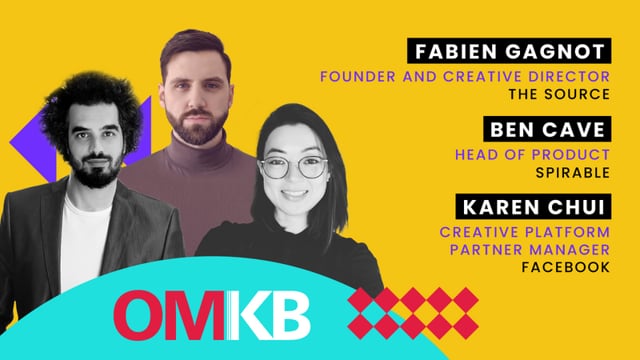
Und ich freue mich auf den nächsten Speaking Slot hier bei uns auf der Mainstage. Und zwar geht es jetzt gleich weiter mit unseren Kollegen von Facebook Business Partners. Hier dazu der passende Speaker Trailer. Let's go! So, da sind wir schon wieder Welcome back und wir kommen zu unserem nächsten inhaltlichen Highlight. Und zwar begrüße ich hier bei uns im Rahmen der OMKB Ben Cave von Spirable Fabienne, Gagne vom the Source und Karin Choi von Facebook. Und die drei werden uns gleich in ihrem Vortrag darüber berichten, wie Technologie und KI dabei helfen kann, widerstandsfähige Kampagnen zu entwickeln. Ich möchte euch ihr kennt das in gewohnter Manier die drei Speaker einmal etwas ausführlicher vorstellen. Fangen wir an mit Ben Cave von Spiral. Ben verbrachte mittlerweile ein Jahrzehnt im Ad Tech Bereich und hat mit Tech Nation eines der weltweit größten Schulungsangebote für Startup Skills in der Vergangenheit entwickelt. Zudem baute er die erste Champion geführte Change Management Plattform bei Team Together. Er ist ein Verfechter für weniger Automatisierung und Maschinen und mehr für den Menschen. Er ist Head of Product bei Spirable seit 2020, war vorher Chief Product Officer bei Team Together in den Jahren 2018 bis 2020 und hat an der University of Nottingham studiert. Herzlich willkommen, Ben, hier auf der Bühne der OMKB. Kommen wir zum nächsten Speaker Fabienne Gagneux von the Source. Fabienne ist Founder und Creative Director bei The Source und Gründer seit 2017 mit am Board. Er bringt zehn Jahre Erfahrung in der digitalen Werbung heute in den gemeinsamen Talk mit Facebook mit ein. Er war Creative Lead bei der zweitgrößten Digitalagentur in Frankreich und hat sie unter anderem mit aufgebaut als erster Mitarbeiter. Er spielt gerne Fußball, er guckt gerne Fußball und ist Vater von zwei Kids und in der Vergangenheit unter anderem auch Co-Gründer gewesen von krc.com, ein Marketplace, spezialisiert auf die Vermittlung von Gebrauchtwagen, der in 2018 von der Renault Group aufgekauft worden ist. Und dann kommen wir zum Host und Gastgeberin des Talks gleich bei unserer OMKB, sponsored by Facebook Business Partners, und zwar Karin Tschoi von Facebook. Sie ist seit fast vier Jahren bei Facebook aktuell in der Position Manager, Partner, Ecosystems and Development für Creative Platforms. Sie war vor ihrer Aktivität Creative Director unter anderem bei der Ninja Ying Limited in den Jahren 2016 und 17, hat bei Saatchi und Saatchi gearbeitet als Senior Creative bei Digitas UK, bringt also mehr als zwölf Jahre Erfahrung im Advertising mit ein als Creative Director. Und gelernt hat sie an der School of Art Institute of Chicago, unter anderem im Bereich Film and Visual Communication. Das heißt, ganz viel EdTech-Erfahrung, Creative-und Design-Erfahrung jetzt in diesem spannenden Panel bei Facebook Business Partners. Ich möchte euch darauf hinweisen, dass aus organisatorischen Gründen dieser Vortrag heute entsprechend als Video eingespielt wird. Das heißt, wir können leider keine Q&A-Session im Anschluss anbieten, gehen dann entsprechend in die kurze Pause. Und für all diejenigen, die sich fragen bei den ganzen Namen und dem hohen Internationalisierungsgrad, der Vortrag jetzt kommt in englischer Sprache zu euch. Ich wünsche euch ganz viel Spaß bei diesem spannenden Thema und sage, wir steigen jetzt direkt ein. Wir sehen uns dann im Anschluss wieder hier auf der Main Stage. Viel Spaß. So hi, my name is Karen and I work for Facebook in their London office and I look after Facebook business partners managing their creative partner specialties in India. So in the last two days youve heard about data privacy, personalisation and how to protect a campaign against signal loss. So in todays conversation were shifting our focus from media buying to the other half of the ad campaign. The creative, according to Nielsen report, fifty six percent of digital campaign performance is attributed to the quality of creative. So in the face of signal loss due to iOS fourteen, the way of your ad creative carries in driving performance is much important than ever before. So in this discussion were going to talk about how can we maximize the fifty six percent of creative performance. How do we leverage technology and the available data to deliver the intelligence and resilient creative. Today we'll be talking to two Facebook business partners, Spirable and The Source. Each of them have creative intelligence tool and their tools use artificial intelligence to help businesses to identify not which, but why certain creative works better than the other. Und to provide you suggestion to optimize your creative. Both of them bring unique perspective to the topic of data personalisation and creative. So now introducing our panelists with Fabian and Ben. I'm gonna let my panelists introduce themselves and their platform in their own words. Hi everybody. So, I'm, uh, I'm Fabian. I'm CEO and, uh, Creative Director at, uh, Desource. Basically, Desource is your mobile first creative excellence partner, going from creative insights to creative production. And Karen mentioned that these 56% of major performance link to creativity, and our job is basically to tackle this, uh, this, uh, this first, uh, performance driver. And how we do it? On one side, uh, we are content makers at scale. Um, we produced over 6000 mobile first videos last year, for example, and, um, we do it thanks to internal tools and inspiration platform to generate, um, thousands of little ideas, uh, in a minute, a powerful workflow and a top class content creators network. And on the other side, we recently launched, uh, Creative Lift, which is an AI based service that spot creative elements, um, that are truly relevant for your customers. And basically, it identifies what we call creative drivers that bring performance within your assets. So basically at the source, we create the best mobile first assets and we measure it. Hi there, I'm Ben. I'm Head of Product at Sparable. Uh, my role is help our customers design and get the most from our platform. Sparable itself is a creative, uh, performance platform that makes it easy to automate, create, distribute and optimize data-driven video at scale. So we're a platform, a SaaS platform, that helps our, um, consumers, uh, from major agencies to the largest brands in the world, uh, to create data-driven, uh, timely relevant video at scale. So creative performance and creative optimization is right at the heart of our entire workflow, from, uh, enabling creative, uh, processes to be better data informed and to make the most of the, the kind of the latest, uh, information improving trafficking and then optimizing in-flight campaigns. So really, our, our tool and our platform is there to give you the complete, uh, creation, uh, trafficking, uh, and optimization experience across all your social channels. Uh, and creative intelligence is powering that. And our AI is at the heart of that, uh, workflow for us. Thank you, Fabian and Ben, and thank you for joining us today. Um, just want to introduce today's session and how it'll go. Our session today has three segments. The first one is a quick myth-busting round where, where you guys will demystify a few of the common misconceptions about creative and tech. The second segment is a Q&A discussion where I'll ask you guys some tough questions about creative intelligence and give you guys a chance to go a little deeper on the subjects. And the third and final segment, we'll do a lightning round on hot topics pressing the industry and give, give your perspective on the future holds. Are you guys ready? Yep. Ready. Awesome. So, myth busting. Um, the first myth: AIs and advancing creative technology will kill creativity. Fabian, what do you think? I think that's a common myth, and, uh, at the Source, we are specifically in the middle of this topic, because on one side, we have creative technology, and on the other side, we do creative production. To me, AI provides data, so we can create data-informed creatives. But still, that's human beings creating at the end. So I think creativity is the highest form of intelligence, and it's an intelligence not easily replicated by machine. So the only thing is that we create with a better creative framework, um, in mind. And an AI can learn, can recognize, can sometimes predict, but creating from scratch ideas that move people will still be a human job. So no, I think AI won't replace anything, but will have better creative ways, better execution, better relevance, and will more than ever have to come up with good ideas. Thank you, Fabian. That's great. Um, so here comes the second myth. Automation lacks human insight. You can't ask the computer to give creative direction. Ben, what do you think? So for this one, I'd have to say partial myth, partial truth. Uh, one of the largest challenges with developing any kind of AI over the past couple of decades, and I- we've been involved in doing so obviously in this field, but the experiences you, uh, replicated across multiple fields, is what we class as intelligence. AI is an amazing rule follower. It's even good at breaking rules within set parameters. Uh, but humans are, as, as Fabian has already noted, um, very good at coming up with a genuinely unexpected ideas. So a lot of this comes down to what do we class as creativity, what do we class as intelligence, and who gives that direction? For me, what works better than an AI on its own or a human being on its own is an AI and a human working together. The concept is called centaurs, and, and it goes back 30 years to chess-playing robots, where an AI and a human being playing chess together would always beat either a human or an AI playing alone. So the same is true of creative direction for me. AI won't detract from the human's ability to make the unexpected call, but it will stop them from making the routine mistake. And those two things together will provide better creative direction. The third myth: Creative technology and tools will replace my job or my creative agency's job. Fabian, what do you think? On this one, uh, you said tools, and I very much like this word, uh, instead of technology, uh, because if you think about it, uh, Photoshop is a creative technology or tool, and we all know Photoshop, and I bet when it came to life, people at creative agencies were, like, "Oh, it's gonna take my job." But at the end of the day, I think since it was born, Photoshop created a lot more jobs than it killed them. So basically, ich denke, creative technology and tools won't take any job, but will probably ch- change some job descriptions und people within creative agencies, uh, will have to embrace these creative tools to inject, still inject the creative ideas, uh, within it and, or thanks to it, like, uh, like, f- for Creative Lift. And they're gonna have to work with it, not compete with it. So for me, I, I kind of, I partially agree, partially disagree with the, with the analysis there. I think the, the part... There is, there is a part of people's jobs, uh, which creative technology is coming for, and that's probably the part which is operating these tools. Uh, but that's the, that's the part which, which, to be honest with you, no one should be particularly excited about doing, because that's, that's simply, it's, it's a base level skill, right? Being able to arrange an art board on Photoshop, being able to use After Effects. These genuinely might become a thing of the past in, in, in 10, 15 years when an AI is able to do the heavy lifting or the routine assembly. What that doesn't take away from, what that doesn't detract from, uh, is the part of the job which I think most, uh, creatives are, are most excited about, which is being genuinely unexpected, coming up with something novel. Administration and routine tasks, as we've seen in sectors like manufacturing, are bound to go to automation. But that doesn't replace the human being in the process. It simply empowers them to do more of the good things. So if you believe that the, the primary value of your job is, uh, operating a tool which others can't operate, then, then maybe you should be a little afraid of creative technology. But if you believe that the primary value of your job is coming up with unexpected creative and empathetic solutions, uh, to, to, to kind of problems in this space, then, uh, you should be excited to have more time to do that. Thank you Fabian and Ben for your delightful answers. It's ge- it gets me really excited about future opportunities with using more and more creative technology because it en- it enables creators to have more time to create better work and more work instead of doing mundane admin wo- admin stuff. So, um, moving on to segment two, this is a Q&A session. Um, I'm gonna ask you guys some tough questions on deeper subjects. Um, so the first question is, how are your clients benefiting today from creative intelligence? Can you share some examples or case studies? Fabian? Basically, Creative Lift, uh, provides a creative framework specifically for clients. So for example, um, Carrefour, uh, one of our clients, got more than 20 new creative rules, what we call creative drivers, um, at Creative Lift, for their direct response ads that were uncovered, uh, using, uh, more, uh, analyzing, sorry, more than, uh, 4,000 assets they were, like, displaying in 2020. So before, they were actually measuring creativity of the impact of creatives with A/B testing, which is a, a good starting point, but still you only compare two creatives and you don't know within the creatives what impact the performance or not. So what if you could test creative, uh, elements at scale, like, within the 4,000 assets? That's actually what Creative Lift, uh, is actually, uh, doing, identifying every creative component of the assets, turning them into data and searching for correlations, uh, with the results these assets got regarding each objective. And you truly learn new things doing this, uh, and I have a, an example, uh, which is about a conversion objective. So for example, I always tell my clients, "Okay, if you have a huge discount or promo on this product, put it up front, from frame, uh, zero in your video. It will have impact." But when using Creative Lift, and especially for Carrefour, we uncovered that it was not the best way for them to drive conversions. Uh, actually it's better to start with the product being used and come with the promotional components at around second three. So that's not, like, a market best practice only for Carrefour, and that's the reality, and actually the funny thing is that it's, uh, it makes us reconsider our own best practices when creating assets. Thank you, Fabian. That's a great example on using AI for your, for your clients. So Ben, what are your most advanced clients doing differently from those who may be lagging behind? It's a great question. Um, I think for me, our most advanced clients are probably doing three things differently. The first is that they have almost entirely done away with the concept of a learn phase followed by a, a run or scale phase, and made learning a constant scaled part of the process for in-flight changes. Now, that's a really big shift in mindset because, you know, we're, we're used to thinking about this as, you know, I test something, I'm done testing that thing, and then it remains static for the rest of my campaign. Uh, but we're seeing our most advanced clients step away from that almost entirely. They're testing in flight, they're testing continuously. They're always seeking out that additional 1% which is gonna contribute to their, to their performance. The second, uh, is to eliminate what I like to call or think of as the canned lion mindset. Let's be very, let's be very transparent and clear here. We're in social video here. Uh, we shouldn't think about our assets or our campaigns or our creatives as, as some golden whole which can't be changed or is, is perfect from the moment it's conceived or created. Uh, we're seeing our most advanced clients really think about all of their creatives as a set of interchangeable components, where a color, a scene structure, a piece of text is all up for grabs, all up for change if it just improves performance a little bit, so rather than a monolithic whole. Um, and the third one, and this is a really, really important one, and this is, this is maybe where, uh, we get into some interesting discussions between us about different approaches is, for us, our most advanced clients are learning to catch their own fish, uh, rather than paying to have a fish caught for them. So they're bringing that capability to do this creative analysis in-house to the teams themselves, um, they're reducing kind of dependence on maybe one-shot, um, one-shot projects to, to create an improved creative or having to go through rounds with their, um, sort of agency to, to produce a new version. And they're really building up that capability for the future because they see creative intelligence and creative performance as being a huge part of what they're gonna do day to day from now onwards. So why not bring that capability in-house? So with the most successful plans of yours or better to go to coming out with ideas and and creative production to be more agile as great just to follow up questions with talk about your most successful plans what are the common mistake that you see advertising Nick and what the getting wrong. Without naming any name is of course I say that the that all of them I am devolved to the idea that creative performance is really ITU cumulative medicine something you need to take for a long time. It's not going to be dramatic from the very first dose, but over time you're going to stack up huge benefits. So the biggest mistakes we see really boil down to either in patients or inconsistency. Now if I take impatience first, often we see brands who expect the first improvement they make to be to have a profound impact on their performance wherethan pay. And what's interesting about that is, they wouldn't apply that same thinking to the media side of their campaign. They're used to making small incremental improvements, consolidating on what's working and gradually over time, sort of driving those one percents which really contribute to a big difference. But when it comes to the creative, some brands expect to change a color by by one hexadecimal and see see a complete kind of a mind blowing a mind blowing up to reality. Is any individual change is probably only going to lead to a small positive improvement. But by consolidating on them over time, you'll really, really get to you really get to those those kind of big wins. The second one is around inconsistency. We do see some advertisers who say, Hey, on this campaign, I want to I want to test and learn. I want to I want to uncover the creative intelligence. But, you know, it's not going to touch the rest of my campaigns over here. We know that if you don't apply those learnings, you're really missing out on the majority of the benefits. So, you know, the mistake to avoid is not leaning into this. A final one, which I can touch on because it's prompted, is, you know, quite often the, the insights which are uncovered by creative intelligence are ones which you probably intuitively know anyway. I know that Fabian brought up the example with Car four of of bringing forward the promotion to, to the top of the creative. And I'll bet you that someone in the in the creative team, they're probably already suspected that that would improve performance. But it's just having the data and the evidence to be able to make that business case or to be able to say with certainty, yes, this is affecting performance and here's how we can fix it. So I think perhaps a final one that I could think of and a mistake is not kind of reading that data incorrect way. So, you know, the most advanced brands and most certainly putting kind of understanding behind that and really using that to build a business case, gradually stack up improvements and in the end see really kind of long term benefits. Fabian Yo clients doing wrong Don't say many names. I want, I want, I think the most come on one I can think about is actually der Internaler Organization Like the Structure of all clients Still very offen. We see the brand and communication department on one side and the performance acquisition department on the other side and the most advanced advertisers have made image or at least if not image like reconciliation between the departments, because they should actually talk to some voice, because they are actually doing the same job. So I think like branding is affecting performance and brand departments can learn a lot from performance indicators and KPIs. And bringing everybody together will also allow everybody to go out from the I like it or I don't like it, you know, like, like this bringing this objectivity that is needed within the social landscape. And yeah, that I am creative capabilities working together should be the norm, which is not from now in most of our clients organizations. Thank you. So we've heard about your successful clients and, and that and, and the kind of not failure, but the mistakes that, that some of them have using creative and technology. What have you learned from, from your clients successes and failure for your business? How does it how has it changed your product or business offering at all from them? Ben, do you want to start? It's a great question and in a high level, yes, we are evolving to meet our clients changing demands. For me, there are really three learnings that I pick out. The first is that to do creative optimization well, advertisers have to have their creative in a place where they can iterate, going multiple rounds with a creative agency to make even the smallest change, or having to wrestle with the black box that is AfterEffects in order to change just a color or a font placement. It simply isn't going to work, particularly not if you're having to do that 20 or 30 times in the course of producing just one creative. So you need something which has the speed to experiment to, to, to make changes fast and even to fail fast so that you can get on with this. And again, to your point, Karen, earlier, this is exactly what advertisers are used to in the media space. So why would you settle for less when it came to your creative? Why would you expect this, this perfect hole to come back? To support this, we've evolved a cloud based creative builder that democratizes that production and edit process so that anyone, regardless of their skill level, can make tweaks and changes. And you don't have to be a practitioner of the AfterEffects dark arts to do that. The second thing is that meaningful pre traffic testing is essential to this process. Again, if I'm making those 20 or 30 changes to a creative in search of better performance, I don't want to have to traffic every single time in anger, place that on a platform and spend real money against it in order to find out if I've made the kind of improvements that I expected to make. Because I'm going to run out of money and I'm going to run out of patience long before I uncover the creative performance I'm after. So to change this. We allow our, um creative building process to test every tweak against its predicted customer retention using our AI tool so that for example if I change an orange background to a yellow background, I can check how that's predicted to change the user attention based on past performance and on the AI analysis of the video before I push that then to the platforms. So that I'm not having to push twenty or thirty times. I can get all my tweaks done, I can test every single tweak and then when I'm ready to push a whole batch of changes, I can do that all in one go. Third and finally, creative success is not a one sizefits all formula. So, you know, whether it's text prominence or facial content or product orientation we know that there is a unique formula for every brand out there which is just waiting to be uncovered which is going to drive their creative performance. That's why we've evolved a historical audit product which basically analyses the last twelve to eighteen months of creative performance, uh, so that we can help our clients understand what's performing for their unique needs, uh, and, uh, we can use that as the starting point for everything that they're doing in the future. Thank you. It sounds like Spybo is doing a lot of automation for your clients and, and for the designers, which is great. Fabien, how has your client changed their business model or your product? I don't ... A few points Ben was, like, uh, saying and I will, uh, jump on the third one you, you mentioned, uh, there is no one-size formula for everybody. And I think on our side, I will talk more about our posture as, uh, as the source and basically the way we present and introduce ourself to, to our clients because before, we used to say, "Hey, we are social media, like, creators. We are specialists. Uh, we know every best practices and we do the best job in the world. And, uh, and, uh, you have to trust us." But now we introduce ourself saying, "We don't know, but we know kind of the path to know, uh, because there is no magic formula." And, uh, I think that's what we learned after this, uh, this, uh, five years, um, that, uh, everything is about testing, iterating and, and the most important thing is that something that works for a client doesn't work for another one. Uh, and that's, uh, that's kind of crazy and makes the job very, very difficult. Uh, so, yeah, we, we, we, we need and we structured ourself to have, like, uh, hundreds of little ideas. Uh, I do ... I, I, I say that in comparison, obviously, with big ideas, uh, creative agencies, uh, always talk about. So our job is to get hundreds of little ideas to test, test, test and find the best one, uh, for each client. So that changes the perspective of the way we present ourself and the way we do our job. Thank you. Thank you, Ben and Fabien. So it sounds like from both of you, the more you at- the more you test, the more you use automation, the better the creator will become and it benefits both agencies, creators, us, and clients. So now we're on segment three. It's lightning rounds on hot topics. So in this round, I'm gonna ask the two of you some hot topics questions a- around the industry. You each have 60 seconds t- to respond to each thing. So the first one: Is personalisation possible in a privacy world? If so, what would personalisation look like? Ben. So for me here, and, and, and this is, you know, first and foremost a personal opinion. Truly personal and creative is something that connects with you. I- it's not something that shoehorns your name or stated hobby into the copy of an ad. Uh, you know, if I look back at a, a classic, like a '50s VW Lemon ad, it was far more personal than a lot of modern advertising, in my mind at least, because it worked hard to build empathy broadly with a great creative, right? And it can be personal to me, and it can be personal to thousands of others in a different way. So in a privacy-first world, my feeling is that the race, uh, will go to those who build creative that their audience instantly recognizes as personal to them without some of the more kind of cheaper personalized touches like bringing in your name or your stated preferences for something, something they've pulled off a cookie. So I think we can do better, and I think that that starts and ends with the creative being more empathetic and connecting more with a broader user base. Thanks, Ben. So Fabien, the next one's for you. Do people want more relevant or, or better ads? What's the difference between relevant ads or better ads? That's an easy one. They want both, uh, I think, uh, because you need quality to stand out of the crowd. Uh, that's, that's for sure. That ... And that's kind of the only way, and you need relevance to actually touch people and make them, like, uh, go into action. So I think what's more interesting is that, um, we tend to have the targeting, so basically kind of the relevance as well, um, within the creatives, uh, itself. Uh, so b- basically, um, I believe in the future, we'll produce way more ads, uh, for the same campaign using different motivators, uh, almost naming the target within the, the creatives in itself, obviously in a, in a, in a cool execution. Um, and then, and then algorithm will make the job and find the right audience for each ad set, so basically qualitative and relevant ad sets at the same time, uh, but a lot of them. So it's, uh, it's, uh, it feeds, uh, the algorithm, uh, to, to, to reach, uh, all targets. Thank you. Ben, what do you think about this? Yeah, it's interesting. Um, I ... To an extent, I agree with Fabien. I think it's a false dichotomy between relevance and quality. Ähm, relevance is kind of, it's become synonymous in the recent past with starting an really kind of narrow plane. How can i, how can i narrow in a creative or a, a very kind of specific add unit to someone's very specific interest at that time? And that way, that way lies retargeting and, and I suspect in the future, that the trend will, will be more towards starting broad with high quality creative, learning continuously and doubling down on what succeeds. That may as, as Fabian say, look like many, many variations algorithmically optimized to an individual's preference. Or it may also look like fewer, better variations which simply connect with a broader audience. The truth is, we don't know until we get testing. But I, I know for sure that the future personalization and, and relevance are not gonna be measured by how well a cookie has been scraped. They're gonna be measured by the quality of the creative and, and how much it connects with an individual. Thank you. So what's the single most important thing for advertisers when they are looking for to choose a creative tech partner? Ben. So, so here I, I suspect Fabian and I will, will slightly diverge, but, but in a healthy way because I think there, there is, there is space for both in the market. For us, I would always say that, you know, without talking my own book too much, ähm, control the means of production yourself, right? Because for the reasons I was talking about earlier, you need this capability within your team. You need the means of producing all these multiple versions, of experimenting quickly, ähm, ah, and of just moving around that within your team. Otherwise you will build up an increasing reliance on, on, ähm, a, a third party or an, an expert elsewhere to do that experimentation on your behalf. And ultimately I think that's, that's a danger for brands moving forward. If you look at the brands who are furthest ahead in this space, ähm, they're thinking about how to bring these capabilities in house. They're thinking about how to make it part of their everyday workflow an, and increasingly they're seeing, äh, almost the, the day job or the primary value of their marketers as being engaged in this continuous testing and experimentation and optimization, äh, of, of both creative and media. So for me I would always say, choose the partner who teaches you to fish, not the one who catches you the fish. Oh, the good old saying. (lacht leise) Fabien, what do you think? That's a good one and actually, äh, äh, I kind of agree, äh, Ben, äh, and, and I think the most, most important thing as, ähm, as an advertiser is to know what you're capable of, äh, to, äh, in terms of managing things in the house. And then you can pick the, the, the right partner. And I would add something else. Äh, is that as creative partner, which is a big word to, to name a lot of things, äh, we are all specialised, äh, in, in one particular thing. And, ähm, I think as an advertiser you have to picture where you want to push the boundaries and then to, to pick the partners that are really specialised in this field, because in this, ähm, evolving world ecosystem, et cetera, we, we cannot do everything super well and I think you need, äh, partners that are really, like, good at one thing. And I would advise not going for all-in-one solutions. Thank you. Here comes a final question of the day. What's the most exciting thing that will happen in the creative technology in the next three years? Fabian, you go first. Äh, I, I, I wi- I would say maturity. Because I, as I was saying, even at, äh, The Source and Creative Leaf, we are, like, experimenting, still, still experimenting. We don't know actually, but we try. Äh, and I think in the next few years, äh, we're gonna, we're gonna be mature. All these technologies will be matures on, äh, on the platform side, like Facebook et cetera. Algorithm will be even better. Our technologies will, will be able to uncover, like, a super good insights, et cetera. And the beauty of it is that it's gonna be the return of creativity at, as its highest level. So, I mean, we'll figure out there can be tools, automation, et cetera, but still, äh, creativity, creative minds, äh, will run the world. So that's, äh, that's, äh... And then the beauty of it is that new technology will come and, äh, and we'll have to go over it again. I like it. Ben, what do you think? Yeah. For me, the, the most exciting trend for the next three years will be democracy. That kind of broader trend in creative technologies everywhere has been putting what used to be elite skills into more and more hands. If I look at, ähm, what a, a tool like Figma has done for, for design, which used to be, you know, this far more specialist skill. Ähm, the more hands it gets into, the freer the marketplace of ideas around this and, äh, the more people you have who gradually replace their hunches with evidence when it comes to creative, because they're able to experiment themselves. They have to ask fewer people's permission, ähm, a- and ultimately that leads to, äh, to a kind of more beautiful ecosystem, in my opinion. Ähm, the most exciting thing that we'll see playing out for advertisers, as trends like hyper-personalisation, you know, sort of come down, I think that the creative will be an even more important piece of the pie. A- and we'll start to see, you know, that rise to surface. As I was saying again, the, the, the kind of the, the message, the, the creativity within the creative, if you like, will, will be even, even more important. A- and in turn that will cause brands to question age-old assumptions about creative and turn to evidence-led testing to drive their, ähm, to drive their performance forward rather than simply hunches, äh, from, from someone who's been doing it that way perhaps for, for a very long time. A- and finally, that will put the power to create and improve creative in more hands and maybe crucially more diverse hands as well. And the result I believe will be abett created mecosystem für everyone. Thank you thank you band und fabian so from today's discussion with learned that creative technology allows enabled more people to create better and mehr ads and not doing altening of the mondane admin work an I do believe that by having more people able zu creating own content it will enable us mor diversity in the advertising industry an uns in soul we will be creating personalis ads for everybody das den kan relate to say thing it ist exciting time indeed. Thank you so much for sharing. Your Time und expertiz heute in this very exciting discussion solo voor audience today if you like to learn more about spire ball oder source you can klick on de link we have shown on screen if you like to learn more about becoming or other facebook business partner. Wir haben eine voll list of our bash creator partners auf website dass die kann scannen ich kurato code on screen dank dir sommer. Danke för habe was. thank you. Musik spielt. Musik spielt.
Automatisch erstellt & redaktionell aufbereitet — kann vereinzelt Fehler enthalten.